menu
Member Sign In
  • IWFS Homepage
  • Blog Home
  • Forums Home
  • Global Forum
  • Contact Us
Close
  • IWFS Homepage
  • Blog Home
  • Forums Home
  • Global Forum
  • Contact Us
    Member Sign In
  • Blog Home
  • Forum Home
  • Global Forum

Follow Us

Recent Posts

  • Ask Sid: What is the new grape being used in Amarone?
  • OUR 2002 RED BURGUNDY HORIZONTAL IS AGING WELL, SHOWCASING REFINED PRECISION WITH TERROIR-DRIVEN CHARM
  • Ask Sid: Thoughts of Sid Cross on the Judgement of Paris historic wine tasting at the 50th Anniversary?
  • EDUCATIONAL #AUSSIEWINE SEMINAR “CLASSIC AND CONTEMPORARY AUSTRALIA” BY KNOWLEDGEABLE MARK DAVIDSON WAS A BIG HIT AT @VANWINEFEST
  • Ask Sid: Was it 50 years since California bested France in a Paris wine tasting?

Archives

  • April 2026
  • March 2026
  • February 2026
  • January 2026
  • December 2025
  • November 2025
  • October 2025
  • September 2025
  • August 2025
  • July 2025
  • June 2025
  • May 2025
  • April 2025
  • March 2025
  • February 2025
  • January 2025
  • December 2024
  • November 2024
  • October 2024
  • September 2024
  • August 2024
  • July 2024
  • June 2024
  • May 2024
  • April 2024
  • March 2024
  • February 2024
  • January 2024
  • December 2023
  • November 2023
  • October 2023
  • September 2023
  • August 2023
  • July 2023
  • June 2023
  • May 2023
  • April 2023
  • March 2023
  • February 2023
  • January 2023
  • December 2022
  • November 2022
  • October 2022
  • September 2022
  • August 2022
  • July 2022
  • June 2022
  • May 2022
  • April 2022
  • March 2022
  • February 2022
  • January 2022
  • December 2021
  • November 2021
  • October 2021
  • September 2021
  • August 2021
  • July 2021
  • June 2021
  • May 2021
  • April 2021
  • March 2021
  • February 2021
  • January 2021
  • December 2020
  • November 2020
  • October 2020
  • September 2020
  • August 2020
  • July 2020
  • June 2020
  • May 2020
  • April 2020
  • March 2020
  • February 2020
  • January 2020
  • December 2019
  • November 2019
  • October 2019
  • September 2019
  • August 2019
  • July 2019
  • June 2019
  • May 2019
  • April 2019
  • March 2019
  • February 2019
  • January 2019
  • December 2018
  • November 2018
  • October 2018
  • September 2018
  • August 2018
  • July 2018
  • June 2018
  • May 2018
  • April 2018
  • March 2018
  • February 2018
  • January 2018
  • December 2017
  • November 2017
  • October 2017
  • September 2017
  • August 2017
  • July 2017
  • June 2017
  • May 2017
  • April 2017
  • March 2017
  • February 2017
  • January 2017
  • December 2016
  • November 2016
  • October 2016
  • September 2016
  • August 2016
  • July 2016
  • June 2016
  • May 2016
  • April 2016
  • March 2016
  • February 2016
  • January 2016
  • December 2015
  • November 2015
  • October 2015
  • September 2015
  • August 2015
  • July 2015
  • June 2015
  • May 2015
  • April 2015
  • March 2015
  • February 2015
  • January 2015
  • December 2014
  • November 2014
  • October 2014
  • September 2014
  • August 2014
  • July 2014
  • June 2014
  • May 2014
  • April 2014
  • March 2014
  • February 2014
  • January 2014
  • December 2013
  • November 2013
  • October 2013
  • September 2013
  • August 2013
  • July 2013
  • June 2013

Meta

  • Log in
  • Entries feed
  • Comments feed
  • WordPress.org

Author Archive

Older Entries
Newer Entries

10 interesting facts about Richard Nixon and wine

June 17th, 2018 by Joseph Temple

Richard Nixon wine

By Joseph Temple

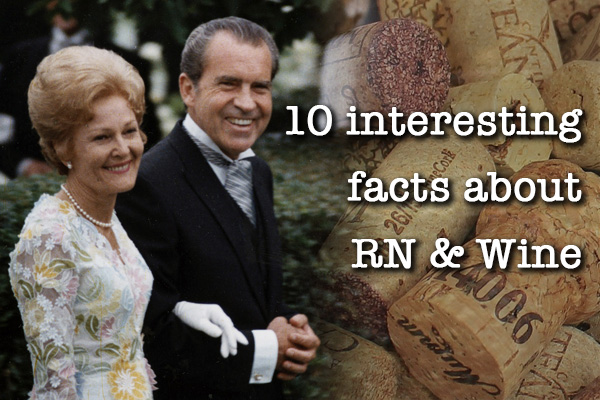
This year marks the 50th anniversary that Richard Milhous Nixon was elected as the 37th President of the United States.  With a passion for drinking only the finest wines, not since Thomas Jefferson had there been a bigger oenophile occupying the Oval Office.  However, this particular subject remains largely unknown when discussing the Nixon legacy—until now! To learn more, have a look below at ten interesting anecdotes that may or may not change your perception of one of the twentieth century’s most polarizing figures.
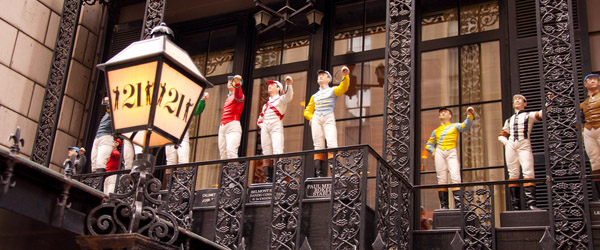


1. Nixon’s interest in wine dates back to his days as a lawyer living in New York City after losing the 1962 California gubernatorial election. During this period, he would always have a bottle of his favorite vintage waiting for him whenever he dined at the 21 Club.
blank
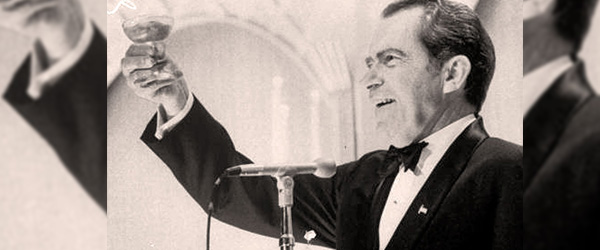

2. Nixon was infamous for drinking first-growth Bordeaux (Chateau Margaux was his favorite) while serving his guests vin ordinaire. In some social circles, this became known as “pulling a Nixon.”
blank
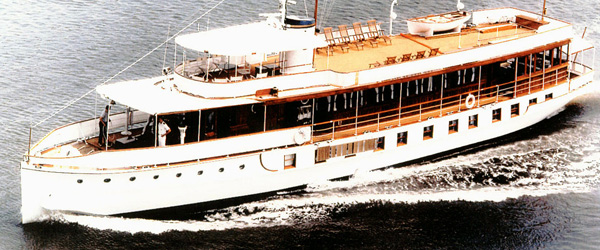

3. During one such incident, while entertaining ten congressmen on board Sequoia, the presidential yacht, Nixon ordered his stewards to serve them six-dollar wine while he drank a thirty-dollar bottle of Chateau Margaux, wrapped in a towel.
blank


4. Aide Alexander Butterfield would be given memos from Nixon about vintages he desired — what Butterfield described as “beaver patrol projects.”
blank


5. Nixon would tell Time Magazine in 1972 that “Sometimes, for an important state dinner, I’ll pick a wine. I do know something about wines.”
blank


6. Although he preferred French wines, Nixon was also eager to promote his home state of California. During his visit to China in 1972, he gave premier Chou En-lai a bottle of Schramsberg sparkling wine. After this fact was revealed, the winery was overwhelmed with orders.
blank


7. According to Henry Kissinger, Nixon was known to slur his words and/or become combative and vulgar after two glasses of wine.
blank


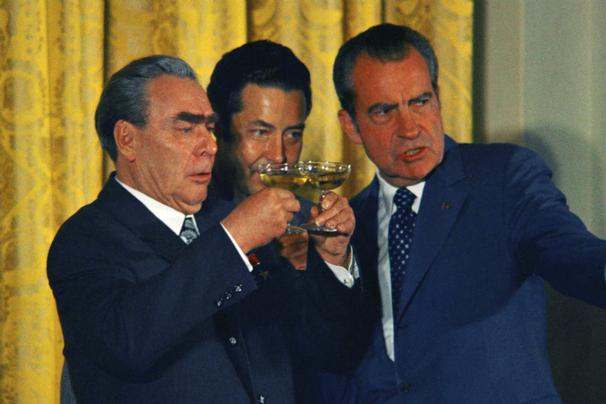
8. To celebrate the signing of the Paris Peace Accords, Nixon asked for the best wine he had: a 1957 Lafite-Rothschild to go with his steak. But this time, everyone got to taste the wine!
blank


9. In his diary, H.R. Haldeman wrote, “Usually it’s just served to the P, and the rest of us have some California Beaulieu Vineyard stuff.”
blank


10. In addition to drinking wine, Nixon also consumed vodka, scotch, brandy and rum.
blank

Sources:

Haldeman, H.R. The Haldeman Diaries: Inside the Nixon White House. New York: G.P. Putnam’s Sons, 1994.
Sullivan, Charles L. Napa Wine: A History. San Francisco: Board and Bench Publishing, 2008.
Reeves, Richard. President Nixon: Alone in the White House. New York: Simon & Schuster, 2002.
Page, Karen and Dornenburg, Andrew. The Food Lover’s Guide to Wine. New York: Little, Brown and Company, 2011.
Will-Weber, Mark. Mint Juleps with Teddy Roosevelt: The Complete History of Presidential Drinking. Washington DC: Regnery History, 2014.
Woodward, Bob & Bernstein, Carl. The Final Days. New York: Simon & Schuster, 2013.
Zraly, Kevin. Windows on the World Complete Wine Course. New York: Sterling Publishing Co., Inc., 2006.


You might also like:
Ask Sid: Why put stems of pinot noir into the fermentation?

June 13th, 2018 by Joseph Temple
Ask your question here

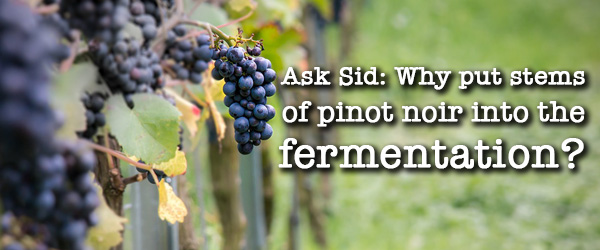
Ask Sid: Why put stems of pinot noir into the fermentation?

Question: Why do some wineries make pinot noir wine by including the stems of the grapes in the fermentation process?

Answer: Yes this is one of the continuing mysteries of the art of winemaking. Some winemakers like to include some stems and use some whole bunches while others don’t. Possible advantages include not only a lowering of the temperature of the fermentation but more bright freshness, finesse, and floral nuances in the wine with a better rounder texture plus elegance. Contrary views often point to old style rustic green herbal notes not wanted resulting from an over complication of the pure grape juice. As vines get older and global warming contributes to riper stems this topic is heating up once again. However in the Okanagan BC opinions are still divided among winemakers. Henricsson Vineyards in Naramata is including 55% stems in their pinot noir but Matt Mavety at Blue Mountain in Okanagan Falls is not including any stems in his. Consider this and decide for yourself what style you prefer.


You might also like:

High Alert: Is a grape change coming soon?

June 10th, 2018 by Joseph Temple

marijuana wine competition

By Joseph Temple

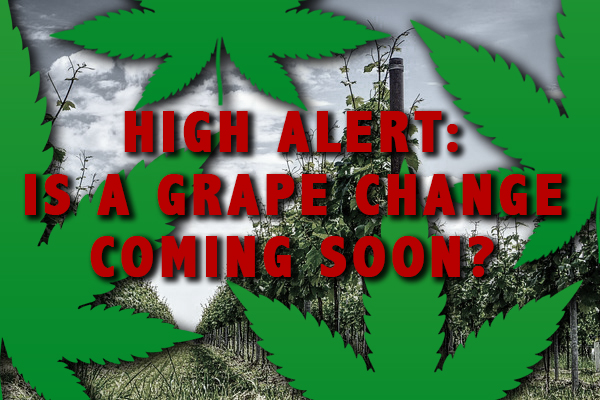
Last month, an article in the Mail Tribune uncovered some startling statistics regarding Oregon’s booming cannabis industry and the threat it now poses to the state’s wine growers.  Discussing the situation in two counties located in southern part of the Beaver State, journalist Damian Mann reports that:

1. The local cannabis industry employs 439 people with a total payroll of $12.58 million while the wine industry employs 355 with a payroll of $10 million.

2. The average wage for someone in the cannabis industry is $33,731 while vineyards pay just $25,478.

Although the sample size is relatively small, a larger question remains: could the situation in southern Oregon be the canary in the coal mine for the wine industry across America as the trend towards marijuana legalization ramps up?

According to a study done in 2014, California, Washington, and Oregon – three of the four largest wine growing states – constitute approximately 94% of all domestic production. At the same time, these three states have also legalized marijuana with California representing the most seismic shift when voters approved Proposition 64 in November of 2016. And although it is still against federal law to sell and distribute the plant, anybody who looks at a map of states that have either fully legalized or decriminalized marijuana can clearly see it growing like an ink blot.

But what does this all mean for wine growers?  Well for starters, the value of real estate just went up dramatically if one switches from harvesting grapes to buds. The Sacramento Bee reports that a prime acre in the Napa Valley dedicated to making wine is estimated to be worth $365,000. However, if the same plot of land was used for cannabis production, that price tag skyrockets to a reported $1.1 million!

“There’s a new agricultural product coming to town. I think we’ll see some of these grapevines be ripped out for cannabis,” said one expert. “If you can plant 1 acre of cannabis and make … a million or more per year, that’s a hell of a lot better than vineyards.”

This trend may be accelerated because some see cannabis as a healthier alternative to alcohol consumption. A 2017 poll conducted by Marist/Yahoo News found that while 75 percent of all respondents believed that wine is much healthier beverage than other alcoholic drinks, 72 percent said they believe that cannabis is much safer than alcohol. “Personal health is particularly important to older consumers. Medical cannabis is now legal in 29 states, and its association with medicine has undoubtedly assuaged consumer fears about cannabis use,” writes the North Bay Business Journal.

What do you think? Can marijuana overtake the wine industry in terms of vineyard acreage? And could it compete directly with wine sales or is it apples and oranges?


You might also like:

Does marijuana pose a threat to the wine industry?

View Results

Loading ... Loading ...

Ask Sid: Which grapes are allowed in Champagne?

June 6th, 2018 by Joseph Temple
Ask your question here

what grapes are used to make champagne

Question: Which grape varieties are allowed in the production of Champagne?

Answer: You usually see only the classic grapes of Chardonnay, Pinot Noir & Pinot Meunier being used these days. However there are actually a total of 6 authorized varieties with 3 secondary ones (often sensitive to frost) less often seen because of their tiny production and usually only in the Aube (region south of Troyes): Arbanne, Petit Meslier, and Pinot Blanc Vrai. Champagne Moutard grows all 6 grape varieties and did release a unique “Cuvee aux 6 Cepages”. Look for these lesser known unique Champage varieties.


You might also like:

Ask Sid: What about the growing vineyards in England and Wales?

May 30th, 2018 by Joseph Temple
Ask your question here

Ask Sid: What about the growing vineyards in England and Wales?

Question: What is happening with increased vineyards being planted in England and Wales?

Answer: Topical question. Production presently is around 2/3 bubbles, 1/4 white wine and the rest around 10% red & rose. Stats for last year show about 135 wineries now with over 700 vineyards. There has been a big increase occurring resulting in a doubling from just over 1000 hectares to 2500 in the last 8 years. Climate change is bullish for quality English sparkling wine! Monitor it.


You might also like:

Older Entries
Newer Entries
The object of the Society is to bring together and serve all who believe that a right understanding of good food and wine is an essential part of personal contentment and health and that an intelligent approach to the pleasures and problems of the table offers far greater rewards than the mere satisfaction of appetite.
Andre Simon Wine & Food Society Founder (1933)
© 2026 The International Wine & Food Society (IW&FS) IW&FS
Credits | Privacy | Accessibility