Question: I hear at wine tastings a lot of different French forest names being used for the oak barrels. Find it a bit confusing including a new one to me called Jupiles. Sid would help clarify all this for me?
Answer: Excellent question because oak is confusing. Oak for wine barrels is now not only coming from France but many other regions around the world. However, the French forests have produced a variety of top quality oak for a long time. Most of them are in Central France but the key to know is the tightness of the grain. Tight grains equal less porous wood and a slower release of the wood tannins. Many other factors influence the impression you get in the wine though including air drying, toasting, new vs used etc. Complicated.
My short list of the main areas would be the following – by generally tightest to looser grain order:
TRONCAIS – central France, Very tight grain ALLIER – central France NEVERS – central France, Medium tightness JUPILLES – most north western forest (Loire Valley) giving a floral character to chardonnay & a favourite of Lucien Le Moine in Burgundy. VOSGES – most north eastern forest (Germany/Alsace border) releases more tannin. LIMOUSIN – near Limoges, More loose grain
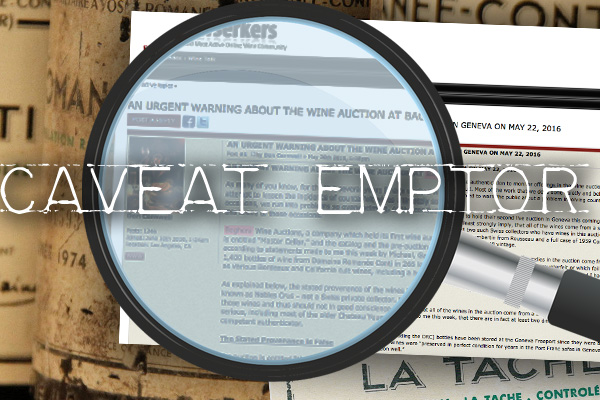
This past Sunday in Geneva, a highly sought-after collection of rare wine bottles including several grand crus from the legendary Domaine de la Romanée-Conti estate went up on the auction block. Owned by an anonymous individual and allegedly stored for 15 years at the Geneva Freeports customs-free zone, Michael Ganne of the Baghera Wines auction house told journalists that this particular auction was “the most important one over the past two decades in continental Europe.”
Then all hell broke loose!
Just days before this supposed treasure trove went under the gavel, a lengthy posting by lawyer Don Cornwell was made on Wineberserkers.com titled “AN URGENT WARNING ABOUT THE WINE AUCTION AT BAGHERA WINE AUCTIONS IN GENEVA ON MAY 22, 2016.” Listing many inconsistencies along with photographic comparisons to substantiate his claims, Cornwell declared, “On very rare occasions, we run into problems so overwhelming, or the conduct is so obviously fraudulent, that I’m forced to warn the public about a problem involving counterfeit wines or wine fraud. Sadly, this is one of those occasions.”
The first lots placed under the microscope contained 1978 Romanée Conti, which Cornwell claims are counterfeit because of the embossed glass—a feature that was only used for the 1974 vintage. Other examples include a 1952 DRC Romanée Conti with a wax capsule (it shouldn’t have one) and a 1961 Petrus Magnum with a falsified label that is clear as day. However, two bottles of 1919 Rousseau Grand Chambertin Vieux Plants didn’t require you to be Sherlock Holmes; a simple Google search would suffice. “Rousseau did not own any vines in Chambertin until 1920,” writes Cornwell. “This is directly stated on Rousseau’s website.”
After these charges went viral, Baghera quickly responded by removing six lots while promising to cancel the sales of any bottles that were suspect. And despite this dark cloud hanging over Geneva, the collection was still able to raise £4.3m according to The Independent. But have these revelations tainted future auctions? Are lingering doubts surrounding authenticity the new norm?
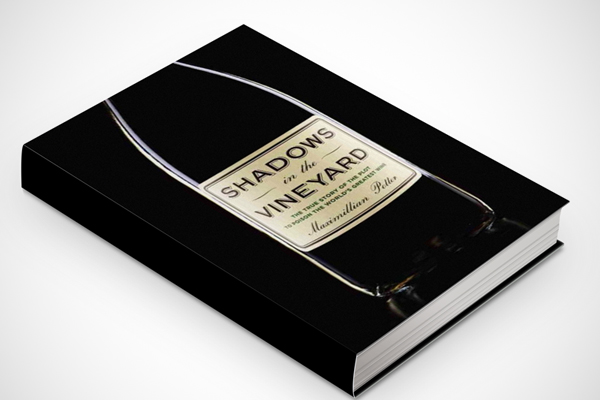
Given the history of wine counterfeiting and the windfall profits that criminals stand to gain, it was almost inevitable that something like this would happen—and will continue to happen. One high-profile case over the past few years was the trial of Rudy Kurniawan. In 2013, this infamous counterfeiter was sentenced to ten years in prison for making millions off blends that were all created in his kitchen sink and labeled with print outs from his computer. Then there were the bottles allegedly owned by President Thomas Jefferson that were auctioned off in 1985, only to be discovered later on that the engraving “Th. J.” was the result of an electric power tool. The entire ordeal surrounding the Jefferson fraud became the subject of author Benjamin Wallace’s 2008 book The Billionaire’s Vinegar, which is slated to become a major motion picture starring Matthew McConaughey.
An important question that remains is what happens to a bottle that is proven to be a forgery? In 2015, the United States Marshals Service created a well-publicized spectacle by destroying over 500 counterfeit bottles belonging to Kurniawan. But is this standard operating procedure for private brokers and retailers? According to Cornwell’s posting, he found one lot containing a 1969 Rousseau Charmes Chambertin that had Rudy’s fingerprints all over it, including an off-center neck label and incorrect numerals. So are plenty of fake vintages still for sale to unsuspecting buyers? Maureen Downey, a fine wine authenticator who responded on Wineberserkers believes so. “Has any vendor ever made a public spectacle of standing up for the good of the consumer, or the market and destroying counterfeits? NO, you haven’t. Because they don’t,” writes Downey. “All these counterfeits are out there, and being sold and resold. And again- it is mostly by brokers, and shady retailers! At least people are monitoring auctions. There is no way to monitor the grey market.”
Question: As you enjoy drinking top quality aged chardonnay I would like to know the best older one from Canada that you have tasted so far in 2016?
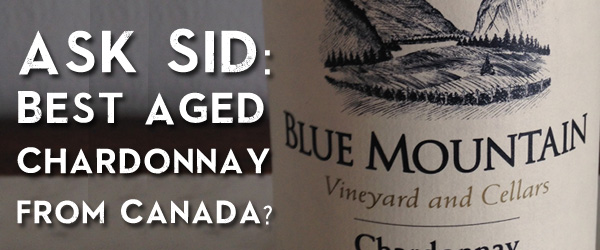
Answer: Tough question. Generally drink my New World chardonnay younger than Burgundy (though pre-mox issues are now a concern for cellaring). Quite a few candidates on the ballot. However, I will vote for 2008 Blue Mountain Vineyard and Cellars (www.bluemountainwinery.com) Estate Bottled from Okanagan Falls in British Columbia. The pioneering Mavety family has farmed the fertile bench overlooking Vaseaux Lake there from 1971 and founded the winery in 1991. They also make fantastic pinot noir that ages magnificently! In 2008 they fermented and aged their chardonnay 50% in French oak barrels for 8 months and the other 50% in stainless steel. Magical combination for the fruit as drinking it in 2016 showed the rich complex smooth nutty flavours from the oak yet balanced fresh finishing lift from the stainless. Lovely complexity and no heat at only 13 alcohol. A very well done aged Canadian chardonnay on a beautiful drinking plateau. Congrats!
This Tuesday marks the 40th anniversary of the Judgment of Paris—a blind tasting that proved to be a decisive turning point in the history of wine. Organized by British merchant Steven Spurrier in honor of America’s Bicentennial, it was perceived to be a lopsided contest between France—the undisputed champion of winemaking—and California, considered by many to be a backwater region known mostly for jug wines and the infamous Thunderbird libation. With most experts predicting that the French would easily steamroll over their competition, every single journalist decided to pass on this event—except for one lucky American in Paris!
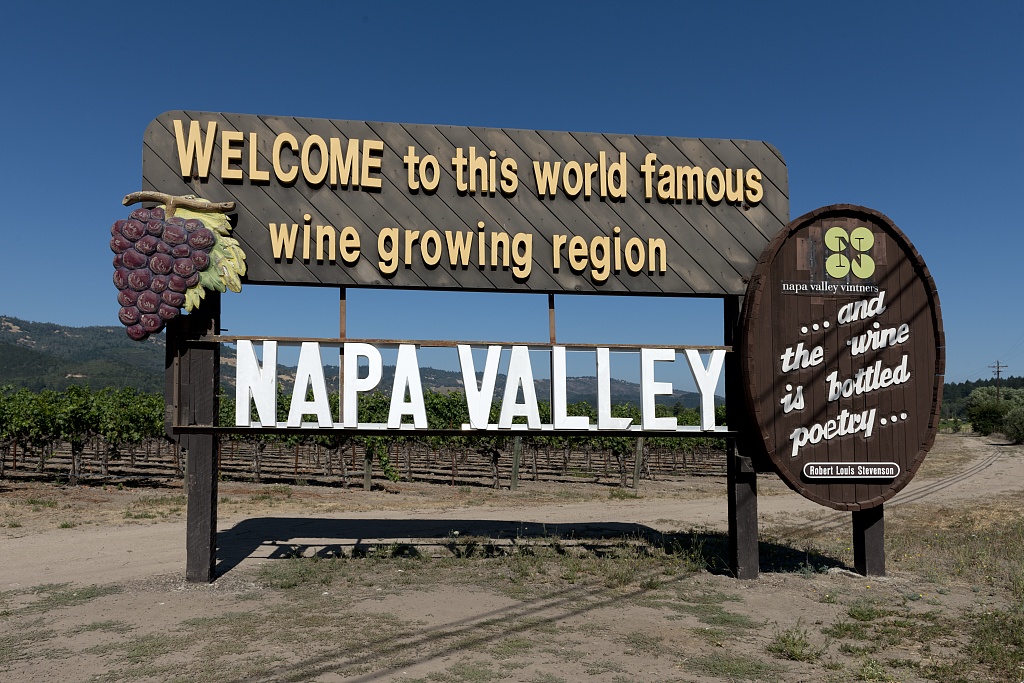
Writing for Time magazine, George Taber ended up getting the scoop of a lifetime when two American wineries, Chateau Montelena and Stag’s Leap Wine Cellars, won for best Chardonnay and red wine respectively. By defeating France and its iconic terroir, the historic tasting marked a seismic shift for wine drinkers. By putting the Golden State on the map, suddenly all the lesser-known regions were given a fighting chance against the French juggernaut. “If the soils of the Napa Valley could produce wines that bested the best of Burgundy and Bordeaux, what could be done in Australia, South Africa, or Chile?” writes the author.
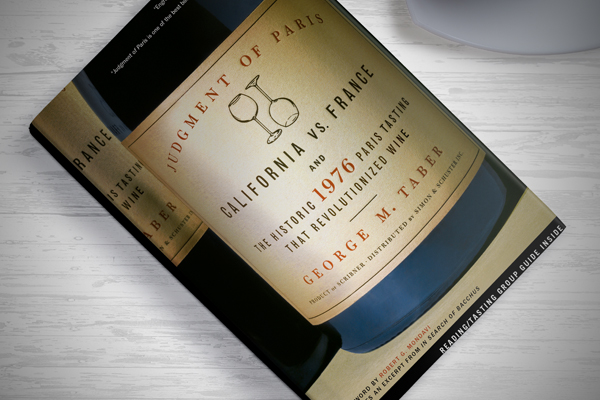
Documenting this Cinderella story in rich detail, Taber proves to be the ultimate primary source when learning all about this game-changing event. In his 2005 book, Judgment of Paris: California Vs. France and the Historic 1976 Paris Tasting That Revolutionized Wine, readers will not only learn about what happened that day at the InterContinental Hotel, but also the unique history surrounding the region that knocked France off its pedestal.
Nearly wiped out after the end of Prohibition, California vintners had faced hard times in the decades leading up the Paris tasting. With lackluster grapes like Alicante Bouschet and fortified wines dominating the marketplace, a complete and total overhaul was necessary in order to compete for global recognition. Like a last-place team rebuilding in hopes of someday becoming a dynasty, California benefitted greatly by drafting a group of eager and determined winemakers. One such individual was Mike Grgich, a Croatian immigrant who battled tooth and nail in getting to America; he eventually became the brains behind Chateau Montelena’s award-winning 1973 vintage. Another was Warren Winiarksi, a Polish-American from Chicago who set up shop in Napa and risked his financial livelihood to create Stag’s Leap Wine Cellars.
Backing up these winemakers was the groundbreaking research being done at the University of California, Davis. Studying the terroir at length, UC Davis decided to divide the state into five climate zones with recommendations for the best grapes to grow in each zone. “They determined, for example, that the Yountville area in the Napa Valley was similar in temperature to the Bordeaux region of France and would be a good area for growing Cabernet Sauvignon,” writes Taber. “While the cooler Russian River Valley region of Sonoma County was more like the Cote d’Or section of Burgundy and would be well suited for cultivating Chardonnay and Pinot Noir.”
Using this information to their advantage, California experienced a colossal transformation in the decade leading up to the Judgment of Paris. For example, according to Taber, from 1961 to 1973, the amount of acres dedicated to growing Cabernet Sauvignon went from 387 to 2,432 and Chardonnay during the same time went from 60 to 785 acres. Reading through the book, you can’t help but root for the underdog while taking in all of these facts, complimented by several uplifting stories of competing winemakers working together for the greater good of the region. Realizing that a rising tide lifts all boats, the author quotes Robert Mondavi who sums it up by stating, “We all understood that the more the whole valley succeeded, the better it would be for each of us in it.”
Leading up to the tasting, readers are given a detailed look at each wine scored by an assortment of mostly French judges. Unlike the film Bottle Shock, which uses a healthy dose of artistic license and focuses exclusively on Chateau Montelena and its owner Jim Barrett, this book takes the time to walk us through all the marvelous wineries featured in this contest, from Château Mouton Rothschild to Freemark Abbey. This is followed up with a brief biographical sketch of the eleven judges, which included Aubert de Villaine and Odette Kahn—who demanded her scorecard back after finding out that California had won.
But arguably the most important chapter of Judgment of Paris comes from the insight Taber offers us in the aftermath of the “buzz heard round the world.” With a readership of 20 million, his Time article was the spark that caused other newspapers to cover this fascinating story, causing wine drinkers across America to rush over to their local shop in search of these hidden California gems. However, if he didn’t show up or the magazine declined to run his piece, could the red-faced French have manipulated the narrative? Taber certainly believes so, writing, “If no one from the press had been present, it would have also been much easier for the French and others simply to deny or distort what had happened.”
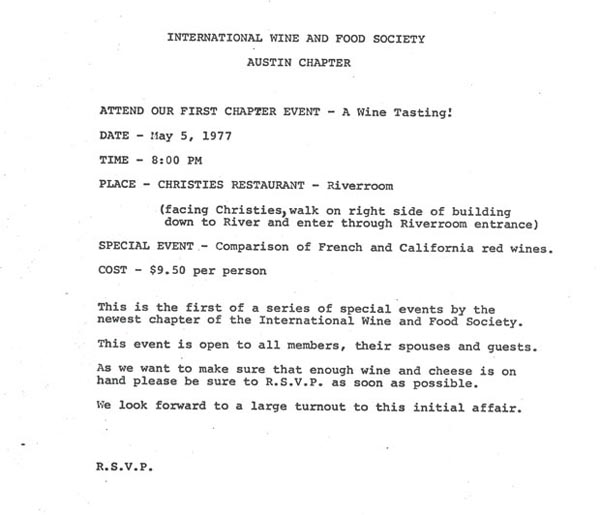
Above: The first event of the IW&FS Austin, Texas Branch –
“A comparison of French & California red wines” – 05/05/1977
Backing up this claim are many in France who, four decades later, still continue to downplay the results, citing numerous inconsistencies that are discussed and debated in the book. While some point to the fact that California had six wines in each category as opposed to only four French wines, others believe that the vintages from France were too young or that Spurrier didn’t select the best ones. Clearly, it is still a sore spot for many French citizens who take enormous pride in being the number one winemaking country in the world.
By interviewing key players along with his firsthand knowledge, Taber has undoubtedly written the definitive account on this legendary tasting. With a narrative that appeals to both seasoned oenophiles and casual wine drinkers, readers are given an important history lesson that impacts the way they purchase and drink wine to this day.
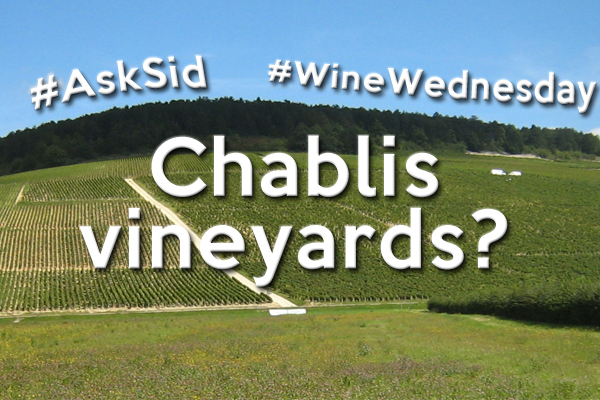
Question: I know you like the top vineyards in Chablis Sid so what is your favorite recent vintage there?
Answer: Yes I continue to admire that distinct terroir shown by some top Premier Cru & most Grand Cru Chablis vineyards. The body of Valmur on clay soils, more delicate floral notes of Vaudesir on limestone and the amazing overall structure with mineral complexity of Les Clos are all Chablis to be respected. There have been increasing frost and hail issues there with variable weather conditions impacting the harvested grapes but some excellent vintages have been produced. My favourite is still 2010 which magically combines a ripe smaller crop of rare intensity combined with a wonderful balanced acidity perfect for longer aging. My next choice as a close runner-up would be 2012. The 2011s are more open forwardly and softer in style for earlier drinking as are the opulent 2009s. 2013 is a less consistent year but some very good wines were produced while 2014 are looking even more promising. Still recommend cellaring some 2010 and 2012.



 Loading ...