Question: I hear some chatter that Pommard Rugiens and Epenots should become Grand Cru vineyards. What are your thoughts on this idea?
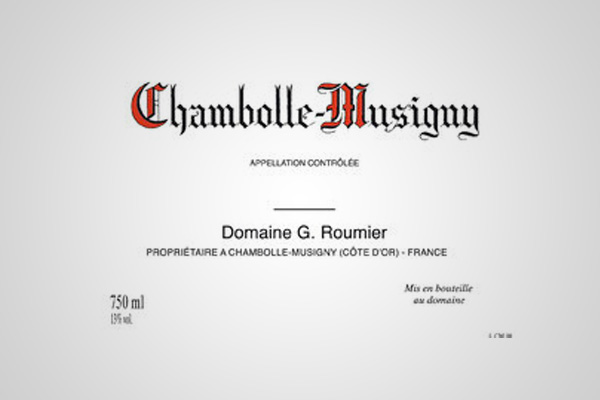
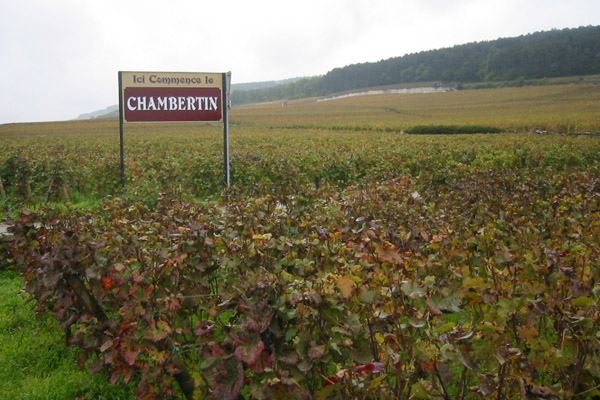
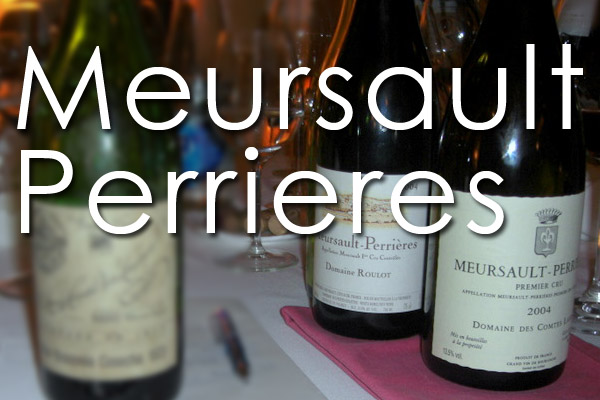
Answer: Yes I have heard that lobby as well. There presently are 27 Premier Cru vineyards in Pommard and no Grand Cru. Certainly Rugiens & Epenots are 2 of their best but both are not totally consistent having different terroirs even within those vineyards. I am sure the INAO are hearing about these and other representations for changes to their original 1936 appellation classification. IMHO there are other vineyards that warrant consideration for elevation to Grand Cru ahead of Pommard. 3 that would be at the very top of my promotion list based on their quality and present price levels would be Chambolle- Musigny Les Amoureuses, Gevrey-Chambertin Clos Saint-Jacques, and Meursault Perrieres!
Get ready to expand your definition of the term “wine tourism”!
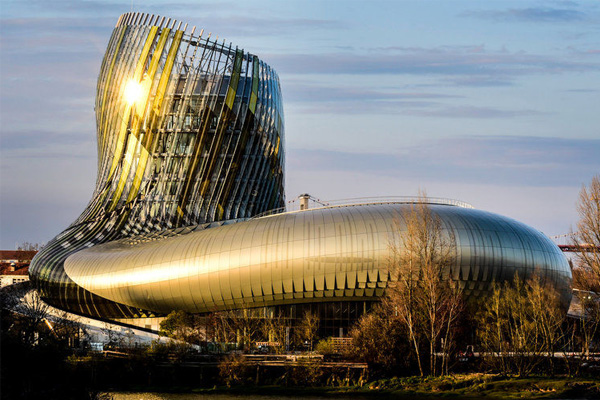
Earlier this month, the city of Bordeaux unveiled a brand new and jaw dropping attraction—La Cité du Vin —a gigantic wine-themed museum that’s guaranteed to lure in oenophiles from across the world. Described as a Disneyland for wine lovers, this ten-story building, which some say looks like a giant decanter, opened its doors to the public after seven long years of construction costing approximately 81 million euros. According to its website, La Cité du Vin “is a unique venue for culture and recreation where wine comes to life through an immersive, sensorial approach, all set within an evocative architectural design.”
With an individual ticket price of €20 (which includes a glass of wine), visitors can expect to be blown away by a number of diverse attractions. For starters, you can head up to the eighth floor to the observation deck known as the Belvedere. Giving locals and tourists a stunning 360° view of the Gironde city, one can enjoy a wine tasting from an updated selection of twenty bottles while soaking in all this gorgeous scenery, from the Place de la Bourse to the Grand Théâtre de Bordeaux. Additionally, the Le 7 restaurant, operated by chef Nicolas Lascombes offers diners another spectacular panoramic view of the city.
Next is the permanent tour, which is described as an “immersive, sensory adventure to discover the cultures and civilizations of wine.” Consisting of twenty different themed areas that explore “the many and varied facets of wine across time and space,” the entire experience is enhanced by cutting-edge technology in the form a travel companion, allowing the visitor to create a virtual travel log in eight different languages.
Then there’s Latitude20, the museum’s wine bar. Housing a collection of 14,000 bottles from 70 different countries, visitors can sample vintages from around the world, from the traditional wine growing regions to the more exotic locations like Bali and Tahiti. Yes, apparently Tahiti makes wine! And once again, technology takes it to the next level with iPad installations that allow you to learn more about the wine you’re about to drink by the world’s top sommeliers.
Of course, America’s footprint can be seen at this theme park whenever you enter the Thomas Jefferson Auditorium. Funded by American Friends of the Cité du Vin (which raised over $300,000 for this project), this theater named in honor of America’s third president (and former ambassador to France) will serve as the venue for movie screenings, debates, presentations and concerts.
According to a story published in USA Today, museum staff has said that you can expect to spend at least 2.5 hours at La Cité du Vin. But don’t think that this attraction is going to take away visitors from the local wineries: While inside you can learn about all about Bordeaux vineyards and even book an excursion. Aiming to draw over 400,000 visitors annually, “the Guggenheim of Wine” according to Bordeaux’s mayor hopes to be one of the twenty most visited museums and parks in all of France. “Wine is part of our cultural and gastronomic heritage but also our landscape,” said French president Francois Hollande at the grand opening. “It symbolizes how France is seen by the outside world; a country of freedom and culture and an emblem of the enviable lifestyle of which we are so proud.”
Question: I was given a bottle of 1998 Burgess Enveiere – is it still drinkable?
Answer: I have visited the historic original Souverain winery on the western slopes of Howell Mountain in the Napa Valley which was taken over by Tom Burgess in 1972. Burgess made some impressive “boutique” wines in the seventies and eighties but as their production increased the winery got more commercial. However, the first Bordeaux styled Enveiere (“to send a message”) was special from 1997 (a great vintage) to celebrate their 25th anniversary in a tall bottle with attractive black & gold labelling. Tasting it shortly after release showed a full rich textured cabernet sauvignon blend with power & lots of spicy new oak. I haven’t tried their 1998 but the year was much cooler resulting in a later harvest with less consistent ripe fruit. Notice your question comes from that beautiful spot of Kona Hawaii. Unless you are only vacationing there warmer storage conditions could also be an issue in favour of earlier drinking. Your 1998 could be drying out now but should nonetheless be lovely drinking showing that hillside cab statement in a more elegant lighter styling. Enjoy it with food!
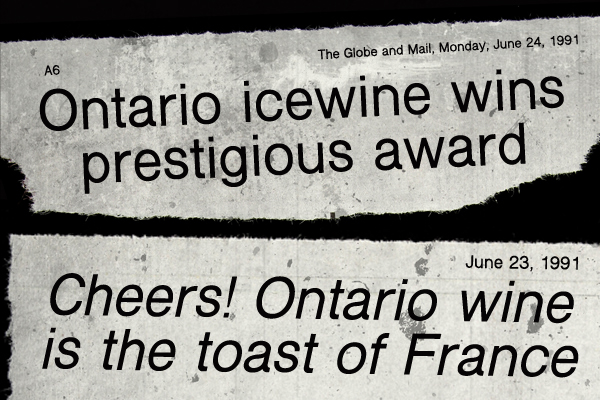
With the Gulf War over and Canadians struggling through a sharp and painful recession, representatives from the Inniskillin Winery crossed the pond in June of 1991 to enter one of their best vintages at VinExpo in Bordeaux, France. Competing against more than 4,000 wines that year, a diverse group of 400 judges went through every single entry over a grueling period of five days. And when it was all said and done, this small upstart from Niagara-on-the-Lake and its 1989 Icewine shocked the world by winning the prestigious Citadelle d’Oro Grand Prix d’Honneur. “This has really put Canada on the international wine map,” said Tony Aspler, wine columnist for The Toronto Star. “I don’t think it’s an exaggeration to say Inniskillin’s entry was the underground hit of the show.”
Fifteen years after the Judgment of Paris, it was now time for America’s neighbor to soak in the spotlight after years of ridicule!
Sharing many parallels with California’s vino-evolution, the province of Ontario also suffered from a reputation of producing wines that were high in alcohol and consumed mainly by individuals looking for a cheap buzz. While the Golden State became infamous for Thunderbird, Canadians of the baby boom era had their own notorious libation known as Baby Duck. But more importantly, just as Napa and Sonoma had turned the corner by making some outstanding wines, Ontario vintners saw a huge opportunity to produce a high quality niche product that would be consumed by oenophiles across the world—Icewine.
Given the first license to create an estate winery since prohibition, Inniskillin blazed the trail in the mid-1970s by planting popular vinifera varieties along the Niagara Peninsula. With some grapes developing a higher concentration of sugar, Icewine, which is picked when temperatures drop to -8°C or below for a sustained period of time, quickly became the region’s unique and hidden gem. Unfortunately, just as many thought at the time that California didn’t stand a chance against Bordeaux and Burgundy, conventional wisdom at the time dictated that German Eiswein was the undisputed champion.
Described as a wine with “a taste reminiscent of tropical fruits and honey,” Inniskillin’s 1989 vintage clearly proved the skeptics wrong. With the undivided attention of 50,000 wine buyers and journalists in Bordeaux, Sylvia Kaiser, the winery’s co-founder’s wife said after winning the Grand Prix d’Honneur, “It’s like winning the film festival at Cannes and walking away with an Oscar in Hollywood.” Echoing this excitement, one French buyer at VinExpo told The Globe and Mail: “Ontario icewine is unbelievable; I’ve never tasted anything like it … It’s so fruity it makes my nose sweat—wonderful.”
Back in Canada, as people read this front-page story, they were disappointed to learn that it would be very difficult to get their hands on this award-winning bottle. With Inniskillin producing only 400 cases of Icewine annually, liquor stores at the time rarely had any bottles for sale; the vast majority was available at only four shops owned by the winery. However, with this whirlwind of free publicity, a gigantic shift in consumer behavior was about to happen.
Following this game-changing victory, production and distribution of Icewine in Ontario skyrocketed from 2,000 cases in 1990 to more than 10,000 cases by 1994 as other Niagara-based wineries got in on this rising market. By the early 2000s, approximately 21,000 cases were being produced, making the region an epicenter for this unique product. Icewine had become a proud symbol of the country’s burgeoning wine industry, being purchased across the globe from New York to Tokyo. And when looking back at the key turning point, Inniskillin’s victory served as an important catalyst, making it worthy of a Canadian Heritage Minute!
Sources:
Cattell, Hudson. Wines of Eastern North America: From Prohibition to the Present—A History and Desk Reference. New York: Cornell University Press, 2013.
Lawrason, David. (1991, June 24). Ontario icewine wins prestigious award. The Globe and Mail. Retrieved from http://search.proquest.com.
van Rijn, Nicolaas. (1991, June 23). Cheers! Ontario wine is the toast of France. The Toronto Star. Retrieved from http://search.proquest.com.
Question: I hear at wine tastings a lot of different French forest names being used for the oak barrels. Find it a bit confusing including a new one to me called Jupiles. Sid would help clarify all this for me?
Answer: Excellent question because oak is confusing. Oak for wine barrels is now not only coming from France but many other regions around the world. However, the French forests have produced a variety of top quality oak for a long time. Most of them are in Central France but the key to know is the tightness of the grain. Tight grains equal less porous wood and a slower release of the wood tannins. Many other factors influence the impression you get in the wine though including air drying, toasting, new vs used etc. Complicated.
My short list of the main areas would be the following – by generally tightest to looser grain order:
TRONCAIS – central France, Very tight grain ALLIER – central France NEVERS – central France, Medium tightness JUPILLES – most north western forest (Loire Valley) giving a floral character to chardonnay & a favourite of Lucien Le Moine in Burgundy. VOSGES – most north eastern forest (Germany/Alsace border) releases more tannin. LIMOUSIN – near Limoges, More loose grain



 Loading ...