menu
Member Sign In
  • IWFS Homepage
  • Blog Home
  • Forums Home
  • Global Forum
  • Contact Us
Close
  • IWFS Homepage
  • Blog Home
  • Forums Home
  • Global Forum
  • Contact Us
    Member Sign In
  • Blog Home
  • Forum Home
  • Global Forum

Follow Us

Recent Posts

  • Ask Sid: Thoughts of Sid Cross on the Judgement of Paris historic wine tasting at the 50th Anniversary?
  • EDUCATIONAL #AUSSIEWINE SEMINAR “CLASSIC AND CONTEMPORARY AUSTRALIA” BY KNOWLEDGEABLE MARK DAVIDSON WAS A BIG HIT AT @VANWINEFEST
  • Ask Sid: Was it 50 years since California bested France in a Paris wine tasting?
  • HORIZONTAL TASTING OF RED BORDEAUX 2015 SHOWS FRUIT FLESHINESS WITH VARIABILITY + OUTSTANDING BENTO BOX
  • Ask Sid: What is Chiavennasca?

Archives

  • April 2026
  • March 2026
  • February 2026
  • January 2026
  • December 2025
  • November 2025
  • October 2025
  • September 2025
  • August 2025
  • July 2025
  • June 2025
  • May 2025
  • April 2025
  • March 2025
  • February 2025
  • January 2025
  • December 2024
  • November 2024
  • October 2024
  • September 2024
  • August 2024
  • July 2024
  • June 2024
  • May 2024
  • April 2024
  • March 2024
  • February 2024
  • January 2024
  • December 2023
  • November 2023
  • October 2023
  • September 2023
  • August 2023
  • July 2023
  • June 2023
  • May 2023
  • April 2023
  • March 2023
  • February 2023
  • January 2023
  • December 2022
  • November 2022
  • October 2022
  • September 2022
  • August 2022
  • July 2022
  • June 2022
  • May 2022
  • April 2022
  • March 2022
  • February 2022
  • January 2022
  • December 2021
  • November 2021
  • October 2021
  • September 2021
  • August 2021
  • July 2021
  • June 2021
  • May 2021
  • April 2021
  • March 2021
  • February 2021
  • January 2021
  • December 2020
  • November 2020
  • October 2020
  • September 2020
  • August 2020
  • July 2020
  • June 2020
  • May 2020
  • April 2020
  • March 2020
  • February 2020
  • January 2020
  • December 2019
  • November 2019
  • October 2019
  • September 2019
  • August 2019
  • July 2019
  • June 2019
  • May 2019
  • April 2019
  • March 2019
  • February 2019
  • January 2019
  • December 2018
  • November 2018
  • October 2018
  • September 2018
  • August 2018
  • July 2018
  • June 2018
  • May 2018
  • April 2018
  • March 2018
  • February 2018
  • January 2018
  • December 2017
  • November 2017
  • October 2017
  • September 2017
  • August 2017
  • July 2017
  • June 2017
  • May 2017
  • April 2017
  • March 2017
  • February 2017
  • January 2017
  • December 2016
  • November 2016
  • October 2016
  • September 2016
  • August 2016
  • July 2016
  • June 2016
  • May 2016
  • April 2016
  • March 2016
  • February 2016
  • January 2016
  • December 2015
  • November 2015
  • October 2015
  • September 2015
  • August 2015
  • July 2015
  • June 2015
  • May 2015
  • April 2015
  • March 2015
  • February 2015
  • January 2015
  • December 2014
  • November 2014
  • October 2014
  • September 2014
  • August 2014
  • July 2014
  • June 2014
  • May 2014
  • April 2014
  • March 2014
  • February 2014
  • January 2014
  • December 2013
  • November 2013
  • October 2013
  • September 2013
  • August 2013
  • July 2013
  • June 2013

Meta

  • Log in
  • Entries feed
  • Comments feed
  • WordPress.org

Author Archive

Older Entries
Newer Entries

Movie Review: Blood Into Wine (2010)

March 27th, 2015 by Joseph Temple

Movie review: Blood into Wine (2010)

By Joseph Temple

***WARNING – SPOILER ALERT***

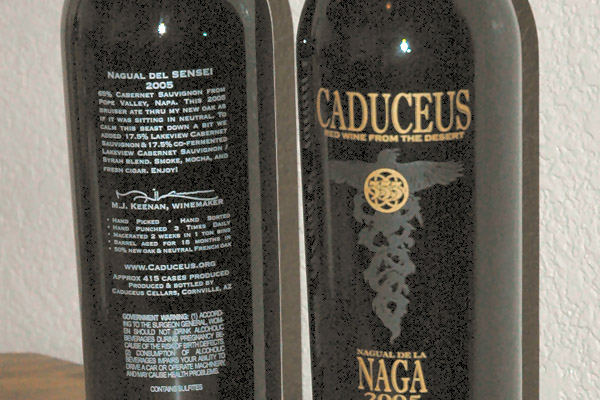
Back in the carefree 90s, if you were a fan of metal, then you definitely listened to Tool.  Formed in 1990, the band’s thundering guitar riffs combined with an avant-garde stage presence made its members into rock royalty with hit songs such as “Sober,” “Stinkfist” and “Schism.” So when I saw that a documentary had been produced about Tool’s eccentric front man, Maynard James Keenan and his second career as an amateur winemaker in northern Arizona, the subject matter definitely peaked my curiosity.

The 2010 film Blood Into Wine, directed by Ryan Page and Christopher Pomerenke sets out to show that Keenan is definitely not your typical celebrity vintner.  Today with everyone from Brangelina to Drew Barrymore buying up lavish vineyards, it has almost become a cliché in Hollywood to own one.  But Tool’s lead singer is clearly different from the rest in that he is no prima donna.  On the contrary, throughout the film, he is very eager to get down on his knees and plant grape vines in the blistering sun.  After all, as his business partner Eric Glomski tells us, the wine business is 90% labor.

Setting up Caduceus Cellars and Merkin Vineyards in the town of Jerome, Arizona, it’s easy to see that Keenan and Glomski are both passionate about being in what they describe as the “frontier of viticulture.”  While many associate the Grand Canyon State with cactus trees and cement that you could fry an egg on, much to my surprise, the situation north of Phoenix is very different.  In fact, during one wine tasting, Keenan tells us that the Verde Valley gets snow in the winter and that he has more problems dealing with the cold frost than he does with the summer heat.

Although a good portion of the film is dedicated to Tool’s front man and trying to figure out what got him so interested in wine, the real star of this film is Glomski. Being an ardent ecologist, he has a gift for telling great stories like how drinking wine furthered his sense of smell and comparing the fermentation process to making tea. Without question, his interviews are what takes the movie to the next level, making it much more than a celebrity-becomes-winemaker narrative.

However, during a tour to promote their latest vintage, we see that the biggest asset for Caduceus Cellars is clearly the star power of its co-owner.  Filming those waiting in line to get their bottles autographed, there appears to be no shortage of Gothic apparel and tattoos bearing the Tool name and logo–not the type of folks you usually associate with wine culture. Obviously with fans more excited to see their rock hero rather than his wine, Glomski jokingly refers to himself as “the guy sitting next to Maynard” during one autograph session at a local grocery store.

But that is what makes Blood Into Wine such a great documentary.  Maynard Keenan’s celebrity status acts as the hook to get people who may have little to no interest in wine to understand more about the subject.  During the film, Keenan willingly shares the spotlight, allowing us to hear from numerous Arizona winemakers about their trials and tribulations in getting the state noticed on the wine map.  And as the viewer gets to see the entire process from the first harvest to when James Suckling of the Wine Spectator judges the final product, you’ll learn a lot more about the industry through this film than a Wine for Dummies DVD.

With a hip soundtrack, colorful characters, excellent camera work and some surprise cameos from Patton Oswalt, Milla Jovovich and Bob Odenkirk, Blood Into Wine serves a great vehicle for getting a crossover audience interested in wine appreciation.


You might also like:

Have you seen Blood Into Wine?

View Results

Loading ... Loading ...

Ask Sid: Arsenic in cheap wine?

March 25th, 2015 by Joseph Temple
Ask your question here The International Wine & Food Society

Should I be worried about arsenic in wine?
Question: I just read a news article about cheap California wines containing arsenic levels that are 500% above what’s considered safe.  Should I be worried about buying a bottle that’s less than $10?  Please let me know what you think?

Answer: Yes I was intrigued by this article and video too that can be viewed here referring to the complaint filed against 26 California wineries in LA Superior Court seeking class-action status because of alleged high levels of arsenic in 83 of the 1306 bottles of wine tested. The report indicates that “nearly all the wines sell for between $5-$10 …and if you’re spending $20 on a bottle of wine you’re not going to have concerns most likely.” However despite the odds I still feel there are concerns at any price level about what is actually in that bottle of wine and therefore I support some form of simple ingredient labeling to be adopted by the wine industry itself to help the wine consumer decide. Read a good detailed article on this subject by John Tilson titled “Caution! What’s In Your Wine?”. They support the innovations in ingredient labeling by Ridge Vineyards & Bonny Doon Vineyards. Caveat emptor “let the buyer beware” still applies.


You might also like:

Are you concerned about the level of arsenic in inexpensive wines?

View Results

Loading ... Loading ...
Bordeaux for beginners: 5 ways to better understand the region

March 20th, 2015 by Joseph Temple

Learning about the Bordeaux wine region
By Joseph Temple

If you’ve started to immerse yourself in the world of wine, it’s almost inevitable that you’ll come across the name Bordeaux.  That’s because with nearly 300,000 vineyard acres, it is France’s largest wine growing region—an area bigger than all of Germany’s vineyards combined and ten times the size of New Zealand’s total acreage.  And matching quantity with quality, it is home to some of the most famous wineries in the world including Château Petrus, Château Margaux and Château Lafite Rothschild.

In addition to centuries of winemaking knowledge, another prime reason for Bordeaux’s continued success is geography.  With its close proximity to both the Atlantic Ocean and several rivers, these bodies of water combined with acres of surrounding pine forests help to temper the region’s climate.  The result is approximately 700 million bottles produced every year from Médoc to Sauternes.

But let’s face it.  If you’re learning about Bordeaux for the first time, things can get quite confusing.  For starters, why aren’t the grapes listed on the bottle like they are for American wines? And what does left bank, right bank and first-growth mean?

Have no fear!  For this week’s entry, we present 5 ways to simplify the Bordeaux region for those who are just starting their journey into the world of wine appreciation. So sit back, relax and learn about one of wine’s most historic and powerful regions.


Is Bordeaux just red wine?
1. When you say Bordeaux, do you mean red wine?

No.  But according to the latest information from the Conseil Interprofessionnel du Vin de Bordeaux, nearly 90% of the region’s grapes are red.  So it’s not hard to see why many people associate Bordeaux with red wine.  However here’s an interesting fact: did you know that until 1970, the region produced more white wine than red on a regular basis?

Despite this seismic shift to red over the past four decades, you can still find some of the world’s best white wines in Bordeaux—most notably in the Graves and Sauternes areas—the latter being home to Château d’Yquem which is renown for its sweet dessert wines, usually made from Sémillon and Sauvignon Blanc grapes.
blank

Bordeaux is a region, not a grape
2. On the label, it says Bordeaux but doesn’t show the grapes used to make the wine. 

Does that mean that Bordeaux is the grape?

No.  Wines from France are named after the appellation where it is grown instead of the grape variety used to make the wine.  If you’re used to drinking American bottles, this can be a bit confusing when trying to figure out if the bottle contains Cabernet Sauvignon, Merlot or some other grape.  Generally speaking, here is the breakdown according to the March 2015 edition of the Wine Spectator:

REDS: WHITES:
Merlot: 65% Sémillon: 49%
Cabernet Sauvignon: 23% Sauvignon Blanc: 43%
Cabernet Franc: 10% Muscadelle: 6%
Petit Verdot: <2% Sauvignon Gris: <2%
Malbec: <2%
Carménère: <2%

Just keep in mind that most Bordeaux wines are a blend of two or more of these grape varieties.
blank

What does left bank and right bank Bordeaux mean?
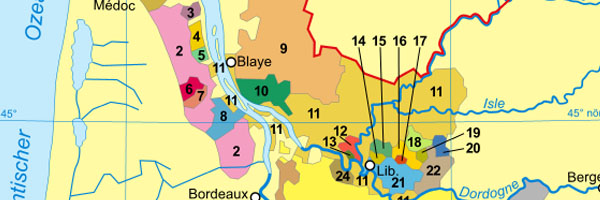
Domenico-de-ga at the German language Wikipedia [GFDL or CC-BY-SA-3.0], via Wikimedia Commons

3. My friends that are into wine were talking about the differences between “Left Bank”
and “Right Bank” Bordeaux.  What does that mean?

When you look at a map of the Bordeaux, you’ll notice that it is divided by the Gironde estuary, which is formed when the Dordogne and Garonne rivers meet in the heart of this wine region.  All appellations left of these waterways are classified as Left Bank and those to the right are known as Right Bank.  For a map listing all the appellations in Bordeaux, click here.

The rule of thumb is that most Left Bank appellations are predominately Cabernet Sauvignon while the Right Bank is centered around Merlot.  The exceptions are Sauternes and Barsac, which only grow white grapes.
blank

Bordeaux first growth - what does that mean?
4. Another term I heard was “first growth.”  What exactly does that mean?

Back in 1855, France hosted the modern-day equivalent of the World’s Fair.  And in preparation for Exposition Universelle de Paris, Emperor Napoleon III asked industry experts to select the best Bordeaux wines to represent the nation.  The result became known as the Official Classification of 1855 with the wines from the Médoc region dominating the list.  Basing their ranking system on the assumption that price equals quality, five different classifications were created, which became known as “growths” with first growths (or Premiers Crus) being the absolute best.  You can view the entire list by clicking here.  So if you’re friends are referring to “first growth,” then it must be either Château Lafite Rothschild, Château Latour, Château Margaux, Château Haut-Brion or Château Mouton Rothschild.
blank

Can I afford to drink Bordeaux?
5. Bordeaux seems quite expensive to drink.

Many articles dealing with Bordeaux are usually illustrated with pictures of opulent Châteaus, leading many to believe that drinking wine from this region is a luxury available only to the very wealthy.  And yes, there are many vintages that can run in the three, four and sometimes five figure range such as Château Petrus and many first growths.  But this is a complete misconception about the region.  In fact, wines priced between $8 and $25 represent approximately 80% of Bordeaux’s total production.  Some of these include Mouton-Cadet, Laurentan, Lacour Pavillon and Baron Philippe.

Sources:

“FAQ About Bordeaux.” Wine Spectator Mar. 2015: 124.
MacNeil, Karen. The Wine Bible. New York: Workman Publishing Company Inc., 2001.
Zraly, Kevin.  Windows on the World Complete Wine Course. New York: Sterling Publishing Co., Inc., 2006.


You might also like:

Do you enjoy Bordeaux?

View Results

Loading ... Loading ...
Ask Sid: Okanagan white wine?

March 18th, 2015 by Joseph Temple
Ask your question here The International Wine & Food Society

Okanagan white wines

Question: I am in my twenties and experimenting with the many Okanagan winery choices available. Sid would you please recommend a good versatile value white for me to try?

Answer: Pleasure. So many styles to choose from. The weather conditions were excellent for both whites and reds now being released from the last 3 consecutive vintages of 2012, 2013, and 2014.  Red Rooster Winery has some consistent well priced quality wines right across the board. Their 2013 Riesling at $17 is so well made by their talented winemaker Karen Gillis showing just off-dry with lovely balanced fresh acidity for the refreshing citric mineral fruit. I am enjoying it often as an aperitif myself at only 12.2 alcohol but it would also match well with fish or lemon chicken dishes. Enjoy it!


You might also like:

Have you tried any wines from the Okanagan Valley?

View Results

Loading ... Loading ...
A look at the wines of Kentucky

March 13th, 2015 by Joseph Temple

Kentucky wine
By Joseph Temple

Mention America’s fifteenth state and many will conjure up images of horse racing, bourbon distilleries and college basketball.  But did you know that before the first thoroughbreds competed at Churchill Downs and prior to Colonel Sanders’ secret recipe, the Commonwealth of Kentucky was the Union’s third largest producer of wine grapes?  Or how about the fact that the America’s first commercial vineyard and winery was founded in the Bluegrass State?  That’s right—before there was Kentucky Bourbon or Kentucky Rain—there was Kentucky Wine.

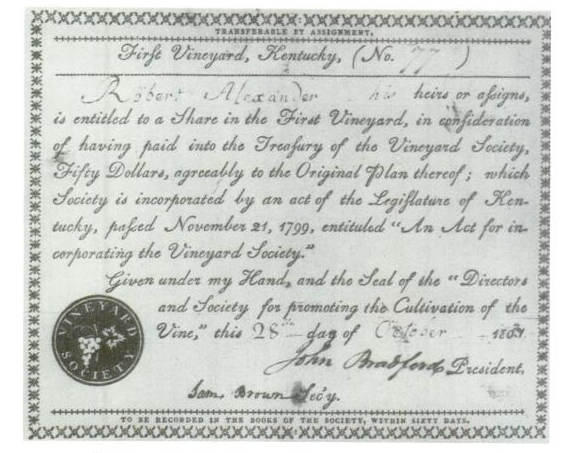
The story begins in 1798 when a Swiss immigrant named Jean-Jacques Dufour traveled across the newly minted nation in hopes of finding the perfect place to cultivate wine.  Stumbling upon what is now Jessamine County on the banks of the Kentucky River, he decided to make this the spot of America’s first commercial vineyard, the aptly named “First vineyard.”  Raising the necessary capital by selling shares of the Kentucky Vineyard Society, a stock company he helped to create, Dufour used the funds to buy more than 600 acres of land and 10,000 vines of over thirty different varieties.  At first, the experiment looked promising with a few bottles even making it into Thomas Jefferson’s wine cellar at Monticello.  However, as most of America’s first vignerons quickly learned, growing Vitis vinifera grapes in the New World was next to impossible during the early 1800s.  And with black rot, Pierce’s disease and phylloxera plaguing the area, Dufour decided to call it quits and head towards the more fertile Indiana territory.  This, however, didn’t mean the end of Kentucky wine–in fact, it was only the beginning.

America's first winery and vineyard
Above: A share in “First Vineyard” issued by the Kentucky Vineyard Society, dated 1799.

Another American wine pioneer that would influence the surrounding region was Nicholas Longworth, a banker and aspiring winemaker living in the border city of Cincinnati.  Following many years of trial and error in the Ohio Valley, he would finally hit the jackpot by growing Catawba grapes, a hybrid of European rootstocks and American Vitis labrusca.  And after accidentally fermenting these musky grapes for a second time, the result was a sparkling libation that transformed the Buckeye State into the largest producer of wine in the United States by 1859.  Of course, this success would soon spill over the Ohio River into Northern Kentucky, which shared a similar climate and geology.  In 1840, the Bluegrass State produced just 2,209 gallons of wine.  Twenty years later, that figure jumped to 136,000 gallons.

Unfortunately over the next hundred years, various diseases, a Civil War and ultimately prohibition would decimate Kentucky’s wine industry as farmers switched over to growing tobacco.  But with that industry now in decline, a winemaking resurgence has taken place over the last few decades.  One vital factor in its comeback has been the state government in Frankfort, which agreed to finance half the startup costs for any new vineyard.   From 1998 to 2002, the grape acreage in the Commonwealth quadrupled with Cabernet Sauvignon, Cabernet Franc and Chardonnay accounting for much of this phenomenal growth.  Moving away from native/hybrid grapes such as Vidal Blanc and Chambourcin, today’s Kentucky vintners seem to share the same pioneering spirit growing vinifera varieties as their ancestors did more than 200 years ago.

Encompassing part of the Ohio River Valley AVA, the Bluegrass State currently has 65 wineries on over 600 acres producing more than 100,000 cases per year.   “The industry is growing by leaps and bounds,” according to Tyler Madison of the Kentucky Department of Agriculture. “It’s an exciting time to be a part of Kentucky wine because it’s all still so new.”  One way to learn more about the state’s best vintages is to check out the winners from the annual Kentucky Commonwealth Commercial Wine Competition and Commissioner’s Cup.  And the next time you’re traveling anywhere from Bowling Green to Lexington, sample some wines from an industry that dates back to the time of Jefferson and is destined for a breakout moment in the twenty-first century.

Sources:

Kentucky’s wine industry: Rich in history, richer in flavor. Go to Louisville. Retrieved from http://www.gotolouisville.com
Fauchald, Nick. (2004, June 28). The Father of American Sparkling Wine. Wine Spectator. Retrieved from http://www.winespectator.com
Loria, Keith. Kentucky Commissioner’s Cup Runneth Over. Farm Flavor. Retrieved from http://www.farmflavor.com
Pinney, Thomas. A History of Wine in America from the Beginnings to Prohibition. Berkeley: University of California Press, 1989.
Tenkotte, Paul and Claypool, James. The Encyclopedia of Northern Kentucky. Lexington: The University Press of Kentucky, 2009.


You might also like:

Have you ever tasted wine from Kentucky?

View Results

Loading ... Loading ...
Older Entries
Newer Entries
The object of the Society is to bring together and serve all who believe that a right understanding of good food and wine is an essential part of personal contentment and health and that an intelligent approach to the pleasures and problems of the table offers far greater rewards than the mere satisfaction of appetite.
Andre Simon Wine & Food Society Founder (1933)
© 2026 The International Wine & Food Society (IW&FS) IW&FS
Credits | Privacy | Accessibility