Answer: Good point! Rot in grapes is generally not noble but a bad thing resulting in decomposition of unhealthy grapes. Grey rot is often still an issue and we remember well the widespread sour rot problems in the Okanagan especially during the 2013 & 2004 vintages. However, healthy ripe grapes in hot misty conditions may be attacked by the fungus botrytis cinerea (particularly in Sauternes, Tokaj, Germany and other unique regions) miraculously turning the individual berries into raisins and concentrating their juice – a noble rot indeed!
Earlier this month, Spectre, the twenty-fourth installment of the James Bond series debuted in movie theaters across North America. Spanning more than fifty years, this enormously profitable franchise has raked in over six billion dollars in box office receipts ever since Sean Connery starred as 007 in 1962’s Dr. No. Featuring exotic locations, gorgeous women and death-defying stunts requiring a suspension of disbelief (see Moonraker), the James Bond character has sustained his enormous popularity with movie going audiences for over half a century. Daring yet culturally sophisticated, the British spymaster is known for many things: fine-tailored tuxedos, a Walther PPK and of course—Martinis, shaken not stirred.
A drink request that is now part of the popular lexicon, Bond has become synonymous with this legendary cocktail. But often overlooked is 007’s passion for fine wines, which is evident in both the Ian Flemming novels as well as the numerous motion pictures from Connery to Daniel Craig. With the expert knowledge of a seasoned sommelier, Bond has put his skills as an oenophile to good use, whether it’s stopping the bad guys or seducing the ladies.
A quintessential example can be seen in 1963’s From Russia With Love. Traveling by train on the Orient Express, Bond has dinner alongside a beauty named Romanova and an assassin who calls himself Nash. Posing as a friendly contact, he blows his cover by committing the ultimate faux pas for wine aficionados. Ordering a grilled sole, the double agent asks for a glass of Chianti to pair with his seafood.
“Red wine with fish—that should have told me something,” shouts Bond as he later battles the armed SPECTRE agent.
And in addition to these food-pairing skills, 007 is quite fond of only the best in terms of bubbly. With the iconic Fontainebleau Hotel providing the backdrop for Bond’s bikini clad mission in 1965’s Goldfinger, even his seductive blonde companion is incapable of luring him back into bed when it is discovered that a bottle of 1953 Dom Pérignon has a temperature above 38 degrees Fahrenheit. “My dear girl, there are some things just aren’t done,” insists Sean Connery who heads toward the fridge with a not-so-subtle jab against the Fab Four. “That’s as bad as listening to The Beatles without earmuffs.”
The ’53 Dom is also referenced in Dr. No when Bond is about to use a lesser vintage as a weapon in his enemy’s underwater lair. “That’s a Dom Pérignon ’55—it would be a pity to break it,” says the evil doctor, which leads 007 to respond with “I prefer the ’53 myself.”
With product placement now a cornerstone of the franchise, many champagne houses have been featured including Veuve Clicquot, Krug and especially Bollinger, which is shown in more than a dozen of the post-Connery Bond flicks. One memorable scene from 1979’s Moonraker features the popular villain-turned-hero Jaws popping open a bottle with his infamous teeth.
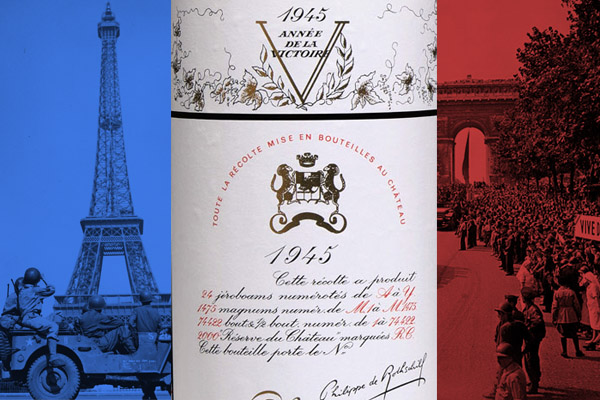
Moving from bubbly to Bordeaux, Bond is able again to unmask his would-be-assassins at the dinner table with their lack of wine knowledge. In 1971’s Diamonds Are Forever, after pouring a bottle of 1955 Mouton Rothschild, 007 comments that “I had rather expected a claret.” When the villain states that they have little claret on board the ship, alarm bells go off since Mouton is from Bordeaux or what the English refer to as claret. So much for posing as an undercover sommelier.
In the book James Bond and Philosophy: Questions Are Forever, the authors write, “He immerses himself in the enjoyment of the best foods, wines and women. The indulgences, which we see in the films, are even more pronounced in the novels—Bond takes such pleasure in the details of creating his own martinis and named them after women, ordering the best caviar, making wine suggestions to the sommelier … He is a true connoisseur.”
Of course, when it comes to drinking the best wines in the world, you only live once—or maybe twice!
Sources:
Held, Jacob M. & South, James B. James Bond and Philosophy: Questions Are Forever. Chicago: Open Court Publishing, 2006. Leigh, David. The Complete Guide to the Drinks of James Bond. Raleigh: Lulu.com, 2010.
Nitins, Tanya. Selling James Bond: Product Placement in the James Bond Films. Newcastle: Cambridge Scholars Publishing, 2011.
Question: I am doing more blind tastings of wines and hoping to be asked as a wine competition judge sometime in the future. What in your opinion is the best skill I can learn to become better?
Answer: Many factors are involved including your taste buds but for me the aromatics are the real key. Broad tasting experience combined with a good wine memory are really invaluable in assessing the quality. Get to know the characteristics shown by the different grape varieties. Do you recognize some familiarity of that grape variety or the style of the blend when you first smell it? I find covering the glass with my hand while swirling the glass initially helps concentrate the aromas for that important explosive first impression. At a tasting yesterday with experienced tasters I again noted that most people seem to have quite different tolerances for faults in a wine like corky TCA and sulphur levels. Your eyesight and hearing now can be improved but your sense of smell and taste are less easily corrected. Some tasters just seem to be more sensitive than others.
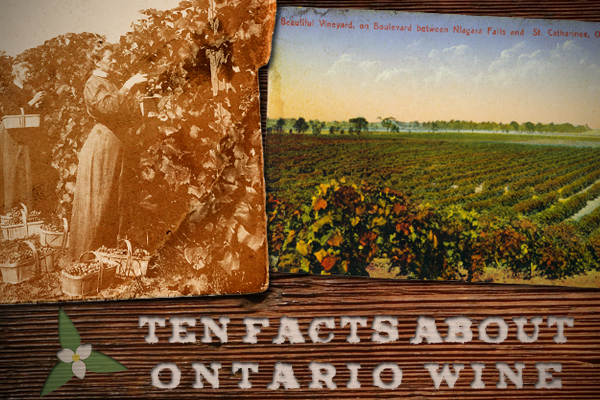
Mention Ontario’s burgeoning wine industry and many people will think of Niagara—a region that is world renown for its award-winning ice wines. But only two and a half hours east of Toronto is another designated viticultural area that’s just waiting to be discovered by oenophiles across the world. Situated on a picturesque peninsula, Prince Edward County, an appellation known for its distinct minerally wines is also Canada’s fastest growing wine region with nearly 800 acres of vitis vinifera vines planted across its scenic shorelines.
With a host of B&B’s, artisan studios and local antique shops, the county’s unique character is undeniable. First settled by United Empire Loyalists (UEL’s) who fled to Canada after the American Revolution, remnants of its British heritage can still be seen in the architecture of its homes and public buildings—making PEC the Canadian equivalent of colonial Williamsburg. And by the start of the twentieth century, it was estimated that an entire third of all canned fruits and vegetables produced in Canada came from Prince Edward, according to historian John Schreiner. Of course, in addition to all this rich history is a wine industry that really took off in the mid-1990s.
Early start-ups in 1996 and 1997 have slowly evolved into thirty-three wineries by 2011. A key selling point during those early years was the price of land, which was considerably lower than what it cost in Niagara. Attracting a group of eager and spirited winemakers, many of them would compare themselves to those who arrived in California during the 1960s to build their empires from the ground up. The only difference is that PEC requires you to pioneer through some brutal winters. “Most winters can get near -30 degrees Celsius for at least a few hours every season. Good winter survival strategies and field practices are a must,” writes one county vintner.
Despite being five degrees cooler on average than the Niagara Region, Prince Edward County has a growing season that is just as long. One reason for this is a ‘lake effect’ that comes from both Lake Ontario and the Bay of Quinte, which moderates the harsh winters synonymous with the eastern part of the province. Another great advantage that PEC has is the direction its plantings face: south and east, the same exposure that European vineyards enjoy.
These comparisons to the old-world don’t stop there either. With limestone soils that yield impressive Chardonnay and Pinot Noir grapes, many vintners in PEC like to compare their vintages to some of Burgundy’s best. “I persist in believing that Pinot Noir … is probably the variety most suited to Prince Edward County,” says visionary winemaker Geoff Heinricks. “There just isn’t enough good Pinot Noir on earth … If we can get it right (and we’ve been dealt a pretty decent hand), then there is a market, a very lucrative, passionate market.”
Sources:
Aspler, Tony & Leslie, Barbara. Canadian Wine for Dummies. Mississauga: John Wiley & Sons Canada, Ltd., 2000.
Cattell, Hudson. Wines of Eastern North America: From Prohibition to the Present—A History and Desk Reference. New York: Cornell University Press, 2013.
Gatehouse, Jonathan. (2003, May 12). Cover: Prince Edward County, Ont: Life’s a beach, with history. Maclean’s, 28, Retrieved from http://elibrary.bigchalk.com.
Gordon, Jim. Opus Vino. New York: Penguin Press, 2010.
Harding, Julia. The Oxford Companion to Wine. Oxford: Oxford University Press, 2015.
Schriener, John. The Wines of Canada. London: Octopus Publishing, 2005.
(2003, July 01). Official guide to the wineries of Ontario. Toronto Life, (7), Insert, Retrieved from http://elibrary.bigchalk.com.
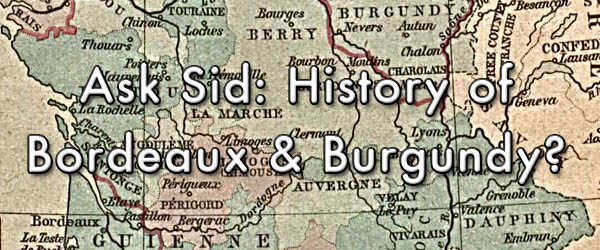
Question: When you read the history of Burgundy, inevitably it is brought up that, due to the Napoleonic Code and the change in French inheritance laws, many vineyards were broken up to the point that there are over 50 owners of, say, Clos de Vougeot. Sometimes owners just have two rows of vines. My question is, why did Bordeaux escape this fate? There are larger vineyards there, and I don’t recall ever reading about how Bordeaux estates were divided to absurdly tiny pieces of property like Burgundy.
Answer: As you indicate in your question it is really the different history of the two regions. The church and monasteries had a really big influence on the Burgundy vineyards way back to the 6th century. They later sold off their large holdings from time to time to “farmers” as smaller land parcels. However inheritance laws that were passed later divided this property between all the owner’s heirs resulting in even smaller fragmented parcels. No large investor. Bordeaux evolved quite differently with initially more wealthy owners of very large properties. More corporate orientated rather than individual owners. Rather than the property having to be split there was cash flow by selling it to their neighbours. Note that Chateau Gruaud-Larose was split into Sarget and Faure for a time but later was reunited by the Cordier family. An alternative example is Pichon was originally one estate in Pauillac but was large enough to divide into both Baron & Lalande and just carry on as two substantial properties. Also there was fresh investment by new owners (like the Chinese are doing presently) setting up large estates. A good example is Chateau Gloria not a presence in 1855 but formed during the 1940s buying up whatever available smaller parcels became available in St. Julien now resulting in a large vineyard estate of over 100 acres. Different culture and history!





 Loading ...

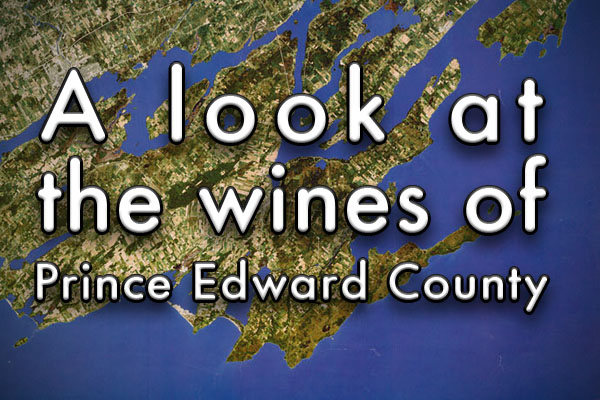 Photo Credit: Library and Archives Canada
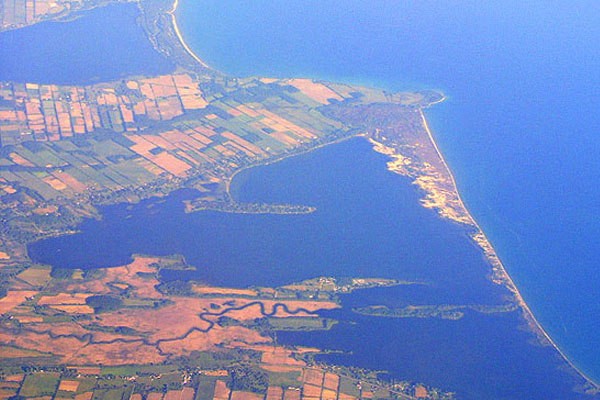 Aerial View of Prince Edward County