menu
Member Sign In
  • IWFS Homepage
  • Blog Home
  • Forums Home
  • Global Forum
  • Contact Us
Close
  • IWFS Homepage
  • Blog Home
  • Forums Home
  • Global Forum
  • Contact Us
    Member Sign In
  • Blog Home
  • Forum Home
  • Global Forum
FOLOW US

Recent Posts

  • Ask Sid: Does sugar level in Sparkling wine affect ageability?
  • ‘TIS THE SEASON FOR YOUR FAVOURITE HOLIDAY COOKIE!
  • Ask Sid: Best wine region for Sylvaner?
  • TOP QUALITY ST. JULIEN CHÂTEAU DUCRU-BEAUCAILLOU VERTICAL SHOWS MIXED RESULTS
  • Ask Sid: What does pigeage refer to in winemaking?

Archives

  • December 2025
  • November 2025
  • October 2025
  • September 2025
  • August 2025
  • July 2025
  • June 2025
  • May 2025
  • April 2025
  • March 2025
  • February 2025
  • January 2025
  • December 2024
  • November 2024
  • October 2024
  • September 2024
  • August 2024
  • July 2024
  • June 2024
  • May 2024
  • April 2024
  • March 2024
  • February 2024
  • January 2024
  • December 2023
  • November 2023
  • October 2023
  • September 2023
  • August 2023
  • July 2023
  • June 2023
  • May 2023
  • April 2023
  • March 2023
  • February 2023
  • January 2023
  • December 2022
  • November 2022
  • October 2022
  • September 2022
  • August 2022
  • July 2022
  • June 2022
  • May 2022
  • April 2022
  • March 2022
  • February 2022
  • January 2022
  • December 2021
  • November 2021
  • October 2021
  • September 2021
  • August 2021
  • July 2021
  • June 2021
  • May 2021
  • April 2021
  • March 2021
  • February 2021
  • January 2021
  • December 2020
  • November 2020
  • October 2020
  • September 2020
  • August 2020
  • July 2020
  • June 2020
  • May 2020
  • April 2020
  • March 2020
  • February 2020
  • January 2020
  • December 2019
  • November 2019
  • October 2019
  • September 2019
  • August 2019
  • July 2019
  • June 2019
  • May 2019
  • April 2019
  • March 2019
  • February 2019
  • January 2019
  • December 2018
  • November 2018
  • October 2018
  • September 2018
  • August 2018
  • July 2018
  • June 2018
  • May 2018
  • April 2018
  • March 2018
  • February 2018
  • January 2018
  • December 2017
  • November 2017
  • October 2017
  • September 2017
  • August 2017
  • July 2017
  • June 2017
  • May 2017
  • April 2017
  • March 2017
  • February 2017
  • January 2017
  • December 2016
  • November 2016
  • October 2016
  • September 2016
  • August 2016
  • July 2016
  • June 2016
  • May 2016
  • April 2016
  • March 2016
  • February 2016
  • January 2016
  • December 2015
  • November 2015
  • October 2015
  • September 2015
  • August 2015
  • July 2015
  • June 2015
  • May 2015
  • April 2015
  • March 2015
  • February 2015
  • January 2015
  • December 2014
  • November 2014
  • October 2014
  • September 2014
  • August 2014
  • July 2014
  • June 2014
  • May 2014
  • April 2014
  • March 2014
  • February 2014
  • January 2014
  • December 2013
  • November 2013
  • October 2013
  • September 2013
  • August 2013
  • July 2013
  • June 2013

Meta

  • Log in
  • Entries feed
  • Comments feed
  • WordPress.org

Archive for 2015

Older Entries
Newer Entries

Ask Sid: Alternatives to Chablis?

June 3rd, 2015 by Joseph Temple
Ask your question here The International Wine & Food Society

Chablis alternatives too expensive

Question: I like the classic pairing of Chablis with oysters and other fresh seafood but notice the prices are rising. Would you please suggest a cheaper alternative?

Answer: Yes the consumer now is recognizing the distinct terroir and fresh minerality of Chablis which is increasing the demand while crop levels have been reduced by difficult weather the last few vintages. Lots of other fresh clean unoaked whites from all corners of the world that will be a good alternative. Okanagan Crush Pad (@OKCrushPad) in the Okanagan are making some lower alcohol dry ones to seek out and experience. There is growing interest in Muscadet from the western end of the Loire Valley  around Nantes. Made from the Melon de Bourgogne grape these wines are much improved in quality many with extended time spent of the lees for extra texture and complexity.  Muscadet has vibrant acidity with citrus, apple, almost salty notes that will pair well with seafood. The prices still are undervalued. Try one.


You might also like:

Are you a fan of Chablis?

View Results

Loading ... Loading ...

Australia’s First Families of Wine

June 1st, 2015 by Sidney Cross

Australi's First Families of wine

Australia’s First Families of Wine (www.australiasfirstfamiliesofwine.com.au/) was created in 2009 by 12 leading multi-generational winemakers representing 16 regions across 4 states. They have just concluded their 2015 tour of USA (San Francisco, New York) and Canada (Montreal Toronto & Vancouver) using a “Speed Dating” tasting format in each city. Each family spends about 5 minutes with a different smaller rotating group showing 2-4 wines. They generously showed with family pride some of the very best wines of Australia. Some highlights:

BROWN BROTHERS  Making wine at Milawa in North East Victoria since 1889. Pure fruit with no wood 2014 Devil’s Corner Pinot Noir from Tasmania and interesting take 2013 Tempranillo 18 Eighty Nine from Heathcote.

D’ARENBERG  Established in McLaren Vale in 1912. Hermit Crab 2014 Viognier Marsanne no oak and 2011 d’Arry’s Original Shiraz Grenache from 130+ year old bush vines.

DE BORTOLI  Third generation from 1928 in Victoria. 2014 Yarra Valley. Estate Grown Pinot Noir 2014 and Noble One Botrytis Semillon 2011.

HENSCHKE  First vineyards planted in the Eden Valley in 1860s. Henry’s Seven Shiraz Grenache Mourvedre Viognier 2013, Mount Edelstone 2010 60th Anniversary of ungrafted vines planted in 1912, and the remarkable 2005 Hill of Grace from 100% Shiraz with original vines over 145 years old.

HOWARD PARK  Cooler Great Southern region in Western Australia. Riesling Porongurup fresh 2014 with developing 2006 and Cab Sauv Abercrombie 2012 with 2008 matured 18 months in French oak.

JIM BARRY  Clare Valley in South Australia. The Florita Riesling 2013 with fresh natural acidity, The Armagh 2006 planted in 1968 low yielding very ripe fruit 15.6 alcohol, and stylish roasty 2002 McRae Wood Shiraz.

McWILLIAM’S  New South Wales back to 1877. Tumbarumba Chardonnay 2013 from higher altitude of 500-800 metres and Cab Sauv 2012 select blocks from Hilltops.

TAHBILK  Five generations with that iconic 1860 Shiraz block in Victoria. 2008 Museum Release Marsanne from world’s largest single plantings of this variety, Shiraz “1860 Vines” from Nagambie Lake made in 150 year old open oak vats (first release 1979), and delicious mellow impressive 1992 Cab Sauv Reserve.

TYRRELL’S  Established in 1858 in Hunter Valley. 2010 Vat 1 Semillon with no malo has brilliant honey character just starting to develop, and 2011 Vat 47 Chardonnay again no malo French oak brought back fond memories of their outstanding 1979 made by Bruce’s father Murray.

WAKEFIELD  Sold hotel business and into the Clare Valley by the Wakefield River. Single Vineyard St Andrews Block 30A Shiraz 2012 & the elegant 2009 The Visionary Cab Sauv.

YALUMBA  Established in 1849 in the Barossa near Angaston. 2014 Eden Valley Viognier 30 year vineyard ripens late to show personality, FDR1A Cab Sauv 78% Shiraz 22% 2005 “emery tannins”, & a just recorked wonderful 1996 The Signature.

CAMPBELLS of Rutherglen is the remaining member but didn’t show any wines in Vancouver.

Have you tried any of these producers? Do Families really make better wine?


You might also like:

Do families make better wine?

View Results

Loading ... Loading ...

The top 3 wine trends of the 90s

May 29th, 2015 by Joseph Temple

The top 3 wine trends of the 1990s

By Joseph Temple

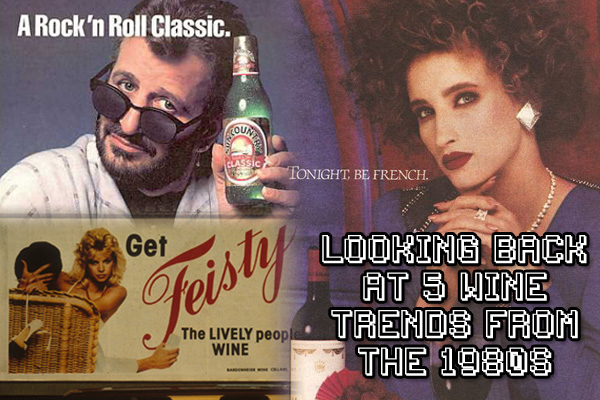
There was such a great response for the blog entry titled Looking back at 5 wine trends from the 1980s posted earlier this month.  Thanks for all the positive feedback about this slice of 80s nostalgia!  So, let’s fast forward into the next decade that gave us Monica Lewinsky, the O.J. Simpson trial and a tech boom that led to unprecedented economic prosperity.

According to Matt Kramer in his book Making Sense of Wine, “The 1990s were the most transforming ten-year span in the history of fine wine.  Everything essential to fine wine—wine grower ambition, a passionate and informed audience and abundant money—coalesced.”  But how did this decade differ and evolve from the one before, which was all about Chardonnay, wine coolers and Beaujolais Nouveau?  Have a look below to see three ways the 90s changed our wine drinking habits.  Cheers.


Wine becomes healthy to drink in the 1990s

On November 17th, 1991, the television program 60 Minutes aired a segment about something called the ‘French Paradox.’  Despite Americans exercising more regularly and eating fewer fatty foods than their counterparts in France, the latter reported far less cases of heart disease.  The only answer to this paradox was red wine, which if consumed in moderation could actually be healthy for you.  It was a clear break from the 1980s where some individuals had lumped wine in with marijuana as a potential “gateway drug.”

Providing an assist to the 60 Minutes piece was an endorsement from the highest office in the land.  Appearing on MTV in 1993, newly elected President Bill Clinton told the interviewer: “if you use it in moderation, there’s no evidence that it causes harm.  And there’s some evidence that wine, for example, is good for your heart if you use it in moderation.”  The idea that a daily glass was good for your health had clearly entered the mainstream as sales of red wine grew by more than 125 percent from 1991 to 2005.
blank
Merlot explodes in popularity during the 90s
By Dianne Patrizzi [CC BY 2.0], via Wikimedia Commons

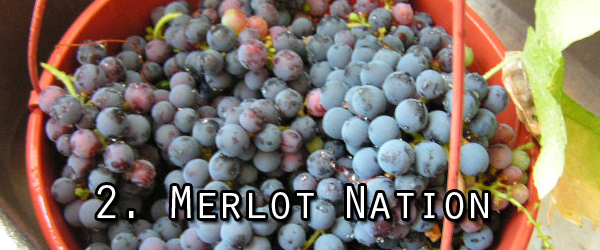
As more and more Americans switched over to red wines during the 1990s, Merlot emerged as the grape of choice for many oenophiles.  Analyzing its popularity, one sommelier writes, “First, it’s easy to pronounce—and, laugh as you may, that’s a big deal.  Second, Merlot is often rounder, plumier, more fruit-forward, and plusher in tannins that many of its counterparts, so it makes for easier and, for many wine drinkers, more pleasant drinking.”  By the mid-1990s, the wine had reached its zenith in terms of popularity as Robert Mondavi and others frantically bought surplus bulk Merlot from France to satisfy American demand.

Benefiting the most from this boom was Washington State.  In a book by Paul Gregutt, he recalls, “By the mid-1990s it seemed that Washington merlot was everywhere … Merlot was both trendy and spendy.  National publications that had scorned Washington as the land of cheap riesling were falling all over themselves to honor the state’s reds, especially its merlots, as the most Bordeaux-like in the land.”  Unfortunately for Merlot lovers, the 90s gold rush resulted in a focus on quantity more than quality, cheapening it in the eyes of many.  More devastating however was a certain award-winning motion picture released in 2004 that made the grape lose its cool factor almost overnight.  In fact, to this day, wine geeks are still debating the impact that Sideways had on Merlot and its drop in sales.
blank
90s tech boom boosts California wine
By Thomas Schanz (Own work) [CC BY-SA 3.0], via Wikimedia Commons

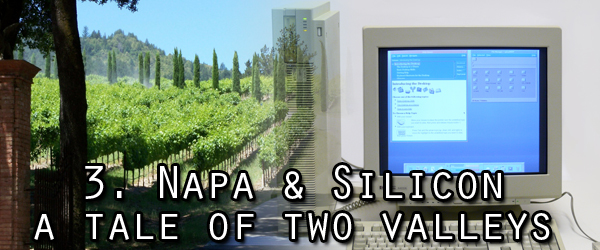
During the dot-com bubble of the 90s, it seemed that a new millionaire was being minted every day as tech stocks skyrocketed to new heights on Wall Street.  And with most of this innovation occurring in California, it wasn’t surprising that the thunderous tide of Silicon Valley lifted a lot of boats throughout the Golden State.  The number of wineries had more than doubled from 807 in 1990 to 1,950 by the end of the decade according to George Taber.  Of course, the rise of the Internet and the phenomenal growth in California vineyards were not mutually exclusive either.  Taber writes, “Some executives were making fortunes at start-up companies in Silicon Valley, not far from Napa Valley.  Those people admired the sophistication that wine represented … Rich people wanted to buy into that by owning a winery.”  Writer James Conway concurred, stating that “a personal wine label for the status conscious had become the twenty-first century equivalent of a coat of arms.”

Sources:

Goldstein, Evan and Esersky, Joyce. Perfect Pairings: A Master Sommelier’s Practical Advice for Partnering Wine with Food. Berkeley: University of California Press, 2006.
Gregutt, Paul. Washington Wines and Wineries: The Essential Guide. Berkeley: University of California Press, 2010.
Page, Karen and Dornenburg, Andrew. The Food Lover’s Guide to Wine. New York: Little, Brown and Company, 2011.
Slinker, Stacy. Idiot’s Guides: Wine. New York: Penguin Group, 2013.
Taber, George. A Toast to Bargain Wines: How Innovators, Iconoclasts, and Winemaking Revolutionaries Are Changing the Way the World Drinks. New York: Simon & Schuster, 2011.
blank


You might also like:

What was your favorite 90s wine trend?

View Results

Loading ... Loading ...

Ask Sid: A cost-friendly alternative to Prosecco?

May 27th, 2015 by Joseph Temple
Ask your question here The International Wine & Food Society

Alternatives to Prosecco

Question: I recently read an article saying that the price of Prosecco is about to go up drastically due to a poor harvest. Can you recommend a cost-friendly alternative to this Italian sparkling wine as summer barbecue season begins?

Answer: I wouldn’t worry too much about the crop shortage or price increases predicted caused by the heavy rains in 2014 as stated by Bisol in that article. Their luxury expensive stony hill Cartizze may be more difficult to find but there are many other competing Prosecco producers out there to supply the light crisp value market which is growing. It is not quite like Grand Cru Chablis where there is a very limited supply every year. Lots of countries now produce well priced fresh bubbles suitable for the BBQ season. I have referred to many of them before including Spanish Cava from Penedes, England (Nyetimber among many), Canada (Benjamin Bridge Nova Scotia; Bub, Bella, Blue Mountain, Cipes, & Steller’s Jay in BC; Trius Rose, Cave Spring, Henry of Pelham, Huff Estate, 13th Street, and Hinterland in Ontario and many more emerging), and from Down Under. At the recent 37th Vancouver International Wine Festival the classy Jansz sparklers from Tasmania were big hits. Check out your wine shop for their latest unique “grower” arrivals.


You might also like:

Will you try one of these recommendations?

View Results

Loading ... Loading ...

Fonseca: 200th Anniversary

May 25th, 2015 by Sidney Cross

Fonseca port wine 200 year anniversary

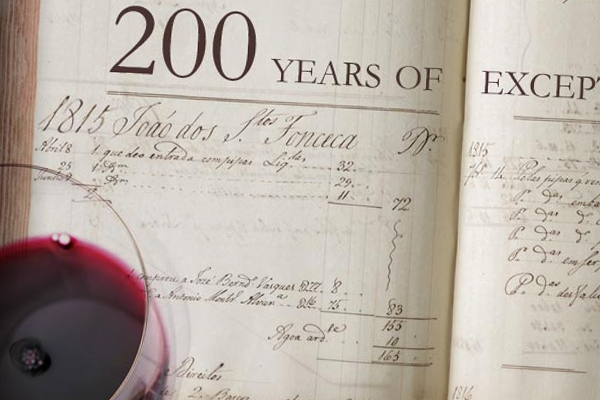
The first evidence of the Fonseca (www.fonseca.pt) firm trading in Port is an entry dated April 8, 1815. Now 200 years later they are a preeminent house with many historic outstanding vintage ports including the 1927, 1945, 1948, 1955, 1963, the surprising 1966, 1977, 1985 (note no vintage for 7 years later in 1992), and 1994 among others. The 6th generation carries on with David Guimaraens who returned to Portugal in 1990 after his broadening wine studies in Australia. No other Port house can claim 6 generations.

David explains the evolution of a bottle of vintage port as follows: “At 2 years it is bottled and you are completely committed to the style and the vintage. The first 10 years it is fruity, rich full bodied – a perfect young ruby port. From 10-20 years a transformation takes place whereby it loses the young berry fruit and bottle age maturity commences – sort of like a teenager who sometimes shows well but at other times doesn’t. From 20-40 years the vintage port develops bottle maturity and is great for drinking but still shows a lot of fruit and vitality. Over 40 years not every one makes this stage but where there is big fruit and big tannins it can go on even longer.” To celebrate their 200 year anniversary we tasted 5 decades with 1970 browning rim, raisins, caramel, spice; 1985 deep red, chocolate coffee buckets of ripe elegant fruit; 1994 produced by David’s father the legendary Bruce has youthful dense blackcurrants & fine tannins; 2000 purple concentrated tannic plums; and 2011 black inky opulent pure blackberries and licorice.

David feels that the end of the Portuguese spirit monopoly in 1991 has improved the product with cleaner finer results. Their neutral grape spirit for Fonseca, Taylor, and Croft now comes mainly from Spain at 3 euros per litre (compared to some others at 1.5 euros) which allows the fruit to show more luscious texture when young, more effective as a teenager and better integrated when old. Even though they still use foot treading of the grapes they take pride in being “the New World of the Old World” with their innovative ongoing changes. Nature rules with emphasis on viticulture, sustainable agriculture, bringing back abandoned grape varieties, understanding the importance of tannins for long aging, and the art of blending. Congrats to this cherished Port house!


You might also like:

Have you tried Fonseca Port?

View Results

Loading ... Loading ...
Older Entries
Newer Entries
The object of the Society is to bring together and serve all who believe that a right understanding of good food and wine is an essential part of personal contentment and health and that an intelligent approach to the pleasures and problems of the table offers far greater rewards than the mere satisfaction of appetite.
Andre Simon Wine & Food Society Founder (1933)
© 2025 The International Wine & Food Society (IW&FS) IW&FS
Credits | Privacy | Accessibility