menu
Member Sign In
  • IWFS Homepage
  • Blog Home
  • Forums Home
  • Global Forum
  • Contact Us
Close
  • IWFS Homepage
  • Blog Home
  • Forums Home
  • Global Forum
  • Contact Us
    Member Sign In
  • Blog Home
  • Forum Home
  • Global Forum

Follow Us

Recent Posts

  • OUR 2002 RED BURGUNDY VERTICAL IS AGING WELL, SHOWCASING REFINED PRECISION WITH TERROIR-DRIVEN CHARM
  • Ask Sid: Thoughts of Sid Cross on the Judgement of Paris historic wine tasting at the 50th Anniversary?
  • EDUCATIONAL #AUSSIEWINE SEMINAR “CLASSIC AND CONTEMPORARY AUSTRALIA” BY KNOWLEDGEABLE MARK DAVIDSON WAS A BIG HIT AT @VANWINEFEST
  • Ask Sid: Was it 50 years since California bested France in a Paris wine tasting?
  • HORIZONTAL TASTING OF RED BORDEAUX 2015 SHOWS FRUIT FLESHINESS WITH VARIABILITY + OUTSTANDING BENTO BOX

Archives

  • April 2026
  • March 2026
  • February 2026
  • January 2026
  • December 2025
  • November 2025
  • October 2025
  • September 2025
  • August 2025
  • July 2025
  • June 2025
  • May 2025
  • April 2025
  • March 2025
  • February 2025
  • January 2025
  • December 2024
  • November 2024
  • October 2024
  • September 2024
  • August 2024
  • July 2024
  • June 2024
  • May 2024
  • April 2024
  • March 2024
  • February 2024
  • January 2024
  • December 2023
  • November 2023
  • October 2023
  • September 2023
  • August 2023
  • July 2023
  • June 2023
  • May 2023
  • April 2023
  • March 2023
  • February 2023
  • January 2023
  • December 2022
  • November 2022
  • October 2022
  • September 2022
  • August 2022
  • July 2022
  • June 2022
  • May 2022
  • April 2022
  • March 2022
  • February 2022
  • January 2022
  • December 2021
  • November 2021
  • October 2021
  • September 2021
  • August 2021
  • July 2021
  • June 2021
  • May 2021
  • April 2021
  • March 2021
  • February 2021
  • January 2021
  • December 2020
  • November 2020
  • October 2020
  • September 2020
  • August 2020
  • July 2020
  • June 2020
  • May 2020
  • April 2020
  • March 2020
  • February 2020
  • January 2020
  • December 2019
  • November 2019
  • October 2019
  • September 2019
  • August 2019
  • July 2019
  • June 2019
  • May 2019
  • April 2019
  • March 2019
  • February 2019
  • January 2019
  • December 2018
  • November 2018
  • October 2018
  • September 2018
  • August 2018
  • July 2018
  • June 2018
  • May 2018
  • April 2018
  • March 2018
  • February 2018
  • January 2018
  • December 2017
  • November 2017
  • October 2017
  • September 2017
  • August 2017
  • July 2017
  • June 2017
  • May 2017
  • April 2017
  • March 2017
  • February 2017
  • January 2017
  • December 2016
  • November 2016
  • October 2016
  • September 2016
  • August 2016
  • July 2016
  • June 2016
  • May 2016
  • April 2016
  • March 2016
  • February 2016
  • January 2016
  • December 2015
  • November 2015
  • October 2015
  • September 2015
  • August 2015
  • July 2015
  • June 2015
  • May 2015
  • April 2015
  • March 2015
  • February 2015
  • January 2015
  • December 2014
  • November 2014
  • October 2014
  • September 2014
  • August 2014
  • July 2014
  • June 2014
  • May 2014
  • April 2014
  • March 2014
  • February 2014
  • January 2014
  • December 2013
  • November 2013
  • October 2013
  • September 2013
  • August 2013
  • July 2013
  • June 2013

Meta

  • Log in
  • Entries feed
  • Comments feed
  • WordPress.org

Author Archive

Older Entries
Newer Entries

Ask Sid: What’s the best way to cleanse your palate?

June 11th, 2014 by Joseph Temple

What's the best way to cleanse your palate?
By No machine-readable author provided. PRA assumed (based on copyright claims). [GFDL or CC-BY-SA-3.0], via Wikimedia Commons

Question: What’s the best way to cleanse your palate?

Answer: This is very personal and unique to every person. What you are trying to achieve is refreshing your mouth to give the next wine a new fresh independent opportunity not influenced by the wine tasted just before it. Saliva does quite a good job on its own. After many wines neutral water or plain bread or crackers helps with the build-up of tannins and refreshes you. A friend of mine likes  special olives. Not me.

Your nose can get fatigued too. Some of us wine judges sniff the water vapours from a water bottle to keep our nostrils moist. At the International Chocolate Awards judging chocolate does linger on your palate more than wine and there we use an effective “soupy polenta” that works well.

Experiment!

Ask Sid Cross about wine and food

How do you cleanse your palate?

View Results

Loading ... Loading ...

5 Retro Food & Drink Ads that make you yearn for a simpler time

June 6th, 2014 by Joseph Temple

5 Retro Food & Drink Ads that make you yearn for a simpler time

By Joseph Temple

While we all wait until 2015 to see how the final season of AMC’s Mad Men ends, let’s have a look at some food and drink advertisements that the real Don Drapers of the time cooked up for TV viewers of the 1960s and early 1970s – an era where catchy jingles reigned supreme.  Looking back, it’s hard to imagine a commercial today lasting more than thirty seconds and yet, some of these spots approach the one-minute mark.   And in today’s fast-paced world, seeing dad at the breakfast table reading (gasp) … a newspaper and not an iPhone only adds to the nostalgic feel of these ads.  So lets take a trek down memory lane with these classics.


1.  Wesson Vegetable Oil … cooks as light as it looks

This commercial is so sugary, you’ll get a cavity just watching it.  If this mother and son duo performs a jingle every time they use vegetable oil, imagine what happens when they break out their favorite bottle of ketchup.


2.  Fanta Orange  … it’s so fun when you’re thirsty

Without question, Coca Cola was king when it came to catchy jingles.  Who can forget “I’d like to buy the world a Coke” or “Things go better with Coke?”  And it looks like Fanta Orange, their sister beverage benefited from the same group of talented writers with this bubblegum tune similar to The Archies “Sugar, Sugar” and Tommy Roe’s “Dizzy.”  Watching a group of hipsters paint their Love Bug in the hot sun, aren’t you glad that they were able to quench their thirst with some refreshing orange soda?


3. Continental Airlines … we’ll really move our tail for you!

With airlines cutting costs and passengers crammed in tighter than a sardine can, you’re lucky these days if you can get one free soda in a small plastic cup.  So imagine coach passengers getting a slice of juicy roast beef with a glass of sparkling wine as you take off to your destination!


4. Instant Quaker Oatmeal gets a celebrity endorsement.

If you’re Quaker Oats and want to reach every housewife in Middle America during the 1960s, who better than Elizabeth Montgomery and Dick York to help sell your oatmeal?  The two stars of the 60s hit show Bewitched prove that making instant oatmeal is as easy as twitching your nose.


5.  Canada Dry Ginger Ale … one gulp if for thirst, the other gulps are for kicks!

If you’re ever shooting pool, hosting a bonfire or partying on a yacht with some scantily clad females, take it to the next step by offering that special lady some champagne – the champagne of ginger ales that is!

Favorite commercial?

View Results

Loading ... Loading ...

Ask Sid: Why does Riesling grow so well in Germany?

June 4th, 2014 by Joseph Temple

Why does Riesling grow so well in Germany
By The original uploader was Simon-sake at Dutch Wikipedia (Transferred from nl.wikipedia to Commons.) [GFDL or CC-BY-SA-3.0], via Wikimedia Commons

Question: Why Does Riesling Grow So Well In Germany?

Answer: This week’s posting on the topic “Riesling: Dry or Sweet?” generated some discussion including this question.  Tough to put your finger exactly on one specific answer. However several important factors come into play that make riesling so successful there.

First is the unique microclimate. Thirteen different wine growing regions so far north around the 50th parallel latitude is crucial. However global warming is having some influence on the weather there. Seems you no longer can be absolutely guaranteed that riesling grown in the Saar will be quite acidic.

But it is not all about only climate but a unique terroir including appropriate soils for such a suitable grape variety like riesling! The regions benefit from the nearby rivers and their distinct soils to absorb heat during the day and retain it during the night. A variety of soils from quartz, sandy loam, clay, silt, graphite, volcanic and limestone contribute different styles. A really big reason for the world-wide admiration of  German riesling is the special Devonian blue gray slate found especially in the Mosel, Saar & Ruwer contributing to their wonderful fruit acidity as well as the structured wines from Rheingau especially around Assmannshausen, Lorch & Rudesheim. There are amazing slopes going straight up from the river bends but also terraces, and rolling hills as well. Quite diverse to say the least!

Ask Sid Cross about wine and food

Does Germany grow the best Riesling grapes?

View Results

Loading ... Loading ...

Wine in China

May 30th, 2014 by Joseph Temple

Wine in China
By Joseph Temple

In 2005, China drastically lowered its tariffs on imported wines from 64% to 14%.  Since then, scores of buyers have made up for lost time by indulging themselves in the fine art of wine tasting — a practice that Chairman Mao’s Cultural Revolution outlawed for being decadent and bourgeois.  Now seldom does a week go by without a news story discussing the impact China is having on wine exports.  Purchasing 1.86 billion bottles in 2013 (a 136% increase in only five years), a whole new generation of oenophiles are springing up from Shanghai to the Himalayas as winemakers around the world eagerly look to cash in.

But what about China’s domestic production? Since almost 95% of the wine consumed in the People’s Republic comes from locally grown grapes, perhaps its time to have a closer look at this potential vino-superpower.

Having a largely superstitious population, it’s no surprise that red wine dominates the marketplace.  That’s because the color red is considered lucky in Chinese culture, while the color white is synonymous with death.  Unfortunately, since the majority of its wine consists of local grapes blended with cheap bulk wine imports, even their finest Cabernet is no match against France or California in terms of quality.  That’s why a sort-of Sino-Franco alliance has been established in recent years.

Beginning in 1978 when China first opened its doors to the West, an influx of foreign wine producers have partnered with government-run businesses to help improve the quality of its vineyards.  Some of these joint ventures have been with notable vintners such as Rémy Martin, Pernod-Ricard and more recently in 2009 when Domaines Barons de Rothschild (DBR) Lafite partnered with China’s biggest state-owned investment company to produce wine geared towards the domestic market.

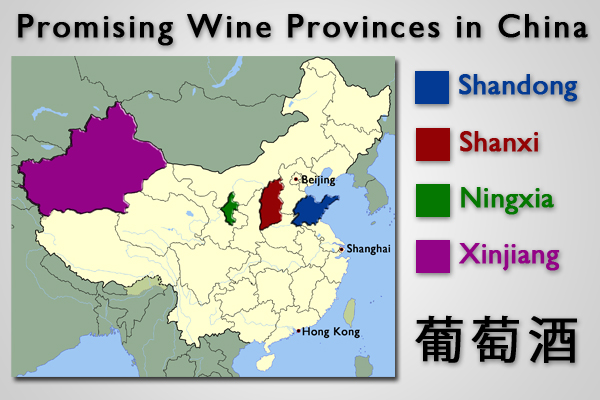
Wine in China map

Setting up shop in the city of Penglai, DBR, like most winegrowers chose the Shandong Province as their hub, which along with the Province of Shanxi benefits from a maritime climate.  Located northwest of Shanghai and south of Beijing, these two provinces share the same latitude as California and would be almost Mediterranean in climate if it weren’t for the raging monsoons.  Of the approximately 500 wineries in China, the majority are located in these two provinces, but that doesn’t mean that there aren’t others that are emerging as well, such as the Mount Helan region and Xinjiang Province on China’s western border.

As of today, Chinese wine has still failed to reach a global audience. But working alongside established vintners to increase quality, the People’s Republic might just be a sleeping giant ready to dominate the global marketplace.   Just remember that fifty years ago, wines from Australia and California were held in similar contempt.

Have you tasted wine from China?

View Results

Loading ... Loading ...

Ask Sid: Should I buy wine on eBay?

May 29th, 2014 by Joseph Temple

Should I buy wine on ebay?

Question: Should I buy wine on eBay?

Answer: Topical question! As a lawyer I always approach any purchase of wine on the internet or at auction with the Latin phrase “caveat emptor” – let the buyer beware! I suggest you should too.

It is somewhat similar to buying a used car. That obviously is a rather major expenditure but top wines with their expensive prices can be costly too.  Ask yourself why is the seller getting rid of that car or that particular wine? Auction houses don’t really like 11 bottle lots because it infers that the seller tried one and didn’t like the case purchase and is dumping it. Now with so much proven counterfeit wine in the marketplace you have to be extra careful that first you are getting the genuine article. Watch out soon for the new documentary film on the Rudy Kurniawan ordeal.  Even if it is an authentic wine you have to be concerned about “hot” storage (was it naturally stored outdoors in Death Valley, California?) and the amount of ullage (space between the cork or screw top and the liquid). Beware of leakage. Remember you are not having the opportunity to hold and examine the wine prior to purchase. Descriptions may not be accurate and any photos posted may not be current enough or detailed enough to alert you to any problem. If it is only 1 bottle and not much money involved it may be worth the adventure and the experience of “gambling” on line. That great buy you think you are getting may not be so endearing when you finally taste it. Once bought you also still have to hope you receive the alcoholic product and in the USA the state by state eligibility of the buyer. Have fun but be careful. I myself would prefer using one of the many online wine shops over eBay.

Ask Sid Cross about wine and food

Have you ever bought wine through eBay?

View Results

Loading ... Loading ...

Older Entries
Newer Entries
The object of the Society is to bring together and serve all who believe that a right understanding of good food and wine is an essential part of personal contentment and health and that an intelligent approach to the pleasures and problems of the table offers far greater rewards than the mere satisfaction of appetite.
Andre Simon Wine & Food Society Founder (1933)
© 2026 The International Wine & Food Society (IW&FS) IW&FS
Credits | Privacy | Accessibility