menu
Member Sign In
  • IWFS Homepage
  • Blog Home
  • Forums Home
  • Global Forum
  • Contact Us
Close
  • IWFS Homepage
  • Blog Home
  • Forums Home
  • Global Forum
  • Contact Us
    Member Sign In
  • Blog Home
  • Forum Home
  • Global Forum
FOLOW US

Recent Posts

  • Ask Sid: Does sugar level in Sparkling wine affect ageability?
  • ‘TIS THE SEASON FOR YOUR FAVOURITE HOLIDAY COOKIE!
  • Ask Sid: Best wine region for Sylvaner?
  • TOP QUALITY ST. JULIEN CHÂTEAU DUCRU-BEAUCAILLOU VERTICAL SHOWS MIXED RESULTS
  • Ask Sid: What does pigeage refer to in winemaking?

Archives

  • December 2025
  • November 2025
  • October 2025
  • September 2025
  • August 2025
  • July 2025
  • June 2025
  • May 2025
  • April 2025
  • March 2025
  • February 2025
  • January 2025
  • December 2024
  • November 2024
  • October 2024
  • September 2024
  • August 2024
  • July 2024
  • June 2024
  • May 2024
  • April 2024
  • March 2024
  • February 2024
  • January 2024
  • December 2023
  • November 2023
  • October 2023
  • September 2023
  • August 2023
  • July 2023
  • June 2023
  • May 2023
  • April 2023
  • March 2023
  • February 2023
  • January 2023
  • December 2022
  • November 2022
  • October 2022
  • September 2022
  • August 2022
  • July 2022
  • June 2022
  • May 2022
  • April 2022
  • March 2022
  • February 2022
  • January 2022
  • December 2021
  • November 2021
  • October 2021
  • September 2021
  • August 2021
  • July 2021
  • June 2021
  • May 2021
  • April 2021
  • March 2021
  • February 2021
  • January 2021
  • December 2020
  • November 2020
  • October 2020
  • September 2020
  • August 2020
  • July 2020
  • June 2020
  • May 2020
  • April 2020
  • March 2020
  • February 2020
  • January 2020
  • December 2019
  • November 2019
  • October 2019
  • September 2019
  • August 2019
  • July 2019
  • June 2019
  • May 2019
  • April 2019
  • March 2019
  • February 2019
  • January 2019
  • December 2018
  • November 2018
  • October 2018
  • September 2018
  • August 2018
  • July 2018
  • June 2018
  • May 2018
  • April 2018
  • March 2018
  • February 2018
  • January 2018
  • December 2017
  • November 2017
  • October 2017
  • September 2017
  • August 2017
  • July 2017
  • June 2017
  • May 2017
  • April 2017
  • March 2017
  • February 2017
  • January 2017
  • December 2016
  • November 2016
  • October 2016
  • September 2016
  • August 2016
  • July 2016
  • June 2016
  • May 2016
  • April 2016
  • March 2016
  • February 2016
  • January 2016
  • December 2015
  • November 2015
  • October 2015
  • September 2015
  • August 2015
  • July 2015
  • June 2015
  • May 2015
  • April 2015
  • March 2015
  • February 2015
  • January 2015
  • December 2014
  • November 2014
  • October 2014
  • September 2014
  • August 2014
  • July 2014
  • June 2014
  • May 2014
  • April 2014
  • March 2014
  • February 2014
  • January 2014
  • December 2013
  • November 2013
  • October 2013
  • September 2013
  • August 2013
  • July 2013
  • June 2013

Meta

  • Log in
  • Entries feed
  • Comments feed
  • WordPress.org

Author Archive

Older Entries
Newer Entries

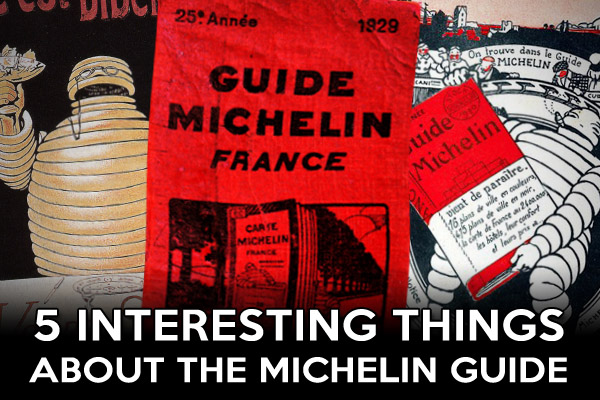
5 Interesting Things About The Michelin Guide
September 2nd, 2016 by Joseph Temple

Michelin Guide history

By Joseph Temple

When André and Édouard Michelin of France decided to create the Guide Michelin in 1900, no one could imagine that they would be changing the face of gastronomy forever. More than a century after the first edition was given away for free, this world famous book now covers the dining landscape of twenty-three different countries and is considered by many travelers to be the culinary bible. As author Michael Steinberger writes, “In time, it became rare to set foot in a French car that didn’t have a well-worn copy of the famous red book in its glove compartment or side pocket, and in a country in which dining truly was a national pastime, the annual publication of the Guide, with its promotions and demotions, was the Oscars of the eating class.”

Originally designed to sell more Michelin tires by making the brand synonymous with driving and travel, these guide books now have the ability to make or break a restaurant through its powerful three star rating system. Earning just one of these stars can increase a restaurant’s revenue by millions, giving Michelin and their inspectors enormous power over the culinary arts around the world.

And when looking back at the history of the guides, it is chopped full of fascinating stories and plenty of controversy. So have a look below at five unique anecdotes that tell the story of the Michelin Guide—it’s definitely worth a journey!!


the first michelin guide 1900
1. Origins

At the beginning of the twentieth century, the whole idea of creating a guidebook for automobile travel was a risky endeavor to say the least. Despite France being the world’s largest market for this new transportation device, the number of individuals who owned one was very small. Considered a niche market for very wealthy people, printing a book containing information about the various hotels and roadways along their route seemed destined for failure.

But as the century progressed, the number of automobiles on the road in France exploded, from just 3,000 in 1900 to over 100,000 by 1914. Taking advantage of this tremendous change, Michelin actively promoted both their products and the guide through clever marketing strategies, which included a cigar-chomping mascot known as Bibendum. As a result, the Guide Michelin quickly became required equipment for all motorists.


restaurant rating system michelin
2. The Addition of Restaurants

Today, the Michelin Guide is often associated with dining and its renowned star system. So it might come as a surprise to some that it wasn’t until the 1920s that Michelin first began to include restaurants in their guidebook. Never explaining their magic formula for what constitutes a coveted three star rating, the people of France nonetheless trusted them wholeheartedly given the company’s reputation. Soon, chefs realized that just one star was their ticket to fame and fortune, especially for those located in the hundreds of small towns across the French countryside, giving them the opportunity of being placed on the culinary map.

With a stronger focus on dining and less on tires, (the 1900 edition devoted 36 of 399 pages to the subject of tires; in 1927, information about tires constituted just 5 of 990 pages total) sales exploded from a printing of 75,000 guidebooks in 1919 to over a million distributed from 1926 to 1940. And no longer were these books free. After Andre Michelin saw them being used to prop up workbenches at a roadside garage, he decided that people only respect what they pay for and began charging seven francs for the book in 1920.


world war i michelin battlefield map
3. A Tool of War

In 1915, as French soldiers were battling the Kaiser’s men in places like Ypres and Champagne, Michelin decided to publish a guidebook to Germany. On the surface, it appeared to be a strange idea, since no motorist was able to freely cross the border. But for Michelin, it was a patriotic exercise designed to boost morale; once they eventually broke through enemy lines, the army would know exactly where to go. Continuing this theme in the post-war period, the company would go on to produce a series of Great War battlefield companions. With such a distinguished reputation, Allied soldiers were given Michelin Guides to help navigate them through liberated France following the invasion of Normandy in 1944.


Exposing the Michelin Guide
4. Controversy

In 2004, Michelin faced a PR catastrophe when Pascal Rémy, an inspector of sixteen years published a scathing tell-all book that pulled back the curtain on some of the company’s most guarded secrets. In the book, he alleges that more than a third of restaurants awarded three stars retain their status only because Michelin views them as untouchable. “It is no longer a priority to look for the good small places in the heart of France,” writes Rémy. “The goal is to bring in money. We have to go to the important places, the big-name restaurants, the big groups—that’s what they say at Michelin now.” While Michelin rejects all these claims, the entire episode does cast serious doubt on their rating system, especially with people these days more likely to reach for their mobile device in search of blogs and restaurant review websites.


restaurants turn in their michelin stars
5. Turning in their stars

The formula for what constitutes a three star rating is a closely guarded secret. As Anthony Bourdain states, “It’s like sausage—no one wants to see how the hell it’s made.” However, many restaurateurs have speculated that décor and not food is what separates two and three stars—a claim that Michelin denies, stating that it is all about what is served on the plate. Requiring millions to upgrade their establishments in order to please inspectors, the result is a more expensive menu, which limits the potential clientele. Additionally, some feel that one must abide by a rigid formula, limiting their creativity in the kitchen. “I know many of the three-star Michelins never change their menu in order to have perfect consistency,” said chef Daniel Boulud. “It’s basically robotic cuisine; they cannot afford to change, because that was the winning formula … Emotionally, I’m going to want to cook something else than what I’ve done.”

Sources:

Clarkson, Janet. Food History Almanac: Over 1,300 Year of World Culinary History, Culture, and Social Influence. Lanham: Rowman & Littlefield, 2013.
Harp, Stephen. Marketing Michelin: Advertising and Cultural Identity in Twentieth-Century France. Baltimore: JHU Press, 2001.
Lottman, Herbert. The Michelin Men: Driving an Empire. London: I.B. Tauris, 2003.
Steinberger, Michael. Au Revoir to All That: Food, Wine, and the Decline of France. New York: Doubleday, 2010.
White, Trevor. Kitchen Con: Writing on the Restaurant Racket. New York: Arcade Publishing, 2006.
Zuelow, Eric. A History of Modern Tourism. Basingstoke: Palgrave MacMillan, 2015.


You might also like:

Have you ever consulted the Michelin Guide?

View Results

Loading ... Loading ...

Ask Sid: Torrontes?

August 31st, 2016 by Joseph Temple
Ask your question here

torrontes wine grape
By nomad_sw18 (originally posted to Flickr as torrentes grape) [CC BY 2.0], via Wikimedia Commons

Question: A friend served me a Torrontes wine. Your thoughts Sid?

Answer: A unique increasingly popular white grape variety that is native to Argentina. For me Torrontes shows very distinctive floral aromatics on the nose of quite ripe peaches combined with some sweetness like a combo of muscat, gewürztraminer, riesling and pinot gris grapes. The best examples often are grown in the northern higher elevation region of Salta. Can be a good aperitif or a food match with particularly Indian and Asian dishes. Try it.


You might also like:

 alt=

Have you ever tried a Torrontes wine?

View Results

Loading ... Loading ...
10 Great and Delicious Icebox Cake Ideas

August 26th, 2016 by Joseph Temple

Icebox Cake recipes

By Joseph Temple

Nothing quite conjures up heartwarming images of yesteryear more than the quintessential “icebox cake.” During a time that saw the meteoric rise of time-saving appliances and convenience foods, it was almost inevitable that a dessert which first got its start during the Roaring Twenties as the “no-bake” cake would become extremely popular in kitchens all across America.

Considered by many to be an evolution of Marie-Antoine Carême’s charlotte, this cake began its ascent after several companies including the National Biscuit Company (now Nabisco) printed recipes for the dessert on their packaging. By utilizing a new and revolutionary appliance known as the icebox—a precursor to the modern day refrigerator, housewives simply couldn’t get enough of this incredibly simple and easy-to-make cake.

Traditionally, the dessert is made by layering sponge cake, wafers or ladyfingers and coating them in whipped cream, custard or pudding. However, there is great room for variation as seen in the hundreds of different recipes that have appeared in various newspapers, cookbooks and magazines for nearly a hundred years. So why not give this cake a 21st century makeover with ten ideas that are sure to impress your friends and family as you put a modern spin on this classic dessert!


traditional - chocolate wafer cookies, whipped cream

 birthday - vanilla cookies, vanilla whipped cream with sprinkles

lemon cookies with thyme infused whipped cream, candied lemon peel, lemon curd

orange ginger - gingerbread cookies, orange marmalade, cream whipped with orange liquor

black forest - chocolate cookies, cherry pie filling, vanilla whipped cream, chocolate shavings

cheesecake - graham crackers, no-bake cheesecake filling, fresh fruit

vanilla cookies, fresh strawberries sliced, vanilla cream

caramel peanut - chocolate cookies, chocolate pudding, caramel, peanuts, peanut butter whipped cream

ice cream - any kind of sandwich cookie (like oreo), any ice cream, chocolate drizzle, whipped cream and cherry on top

chocolate cookies, espresso, coffee liquor, mascarpone cream, cocoa powder

Sources:

Byrn, Anne. American Cake: From Colonial Gingerbread to Classic Layer, the Stories and Recipes Behind More Than 125 of Our Best Loved Cakes. New York: Rodale, 2016.
Sagendorph
, Jean & Sheehan, Jessie. Icebox Cakes: Recipes for the Coolest Cakes in Town. San Francisco: Chronicle Books, 2015.


You might also like:

Have you ever had an Icebox Cake for dessert?

View Results

Loading ... Loading ...
Ask Sid: Band-Aid Aromas?

August 24th, 2016 by Joseph Temple
Ask your question here

wine that tastes like a band aid

Question: I opened a red wine that smelled just like a box of Band-Aids in a jar of grape jam. What would cause that?

Answer: Quite a description! Not sure what your wine is but quite likely to be a young ripe Shiraz (or syrah) with that typical jammy sweet fruit that was tainted by the antiseptic-like notes of brett (brettanomyces). This is a wild yeast (pronounced brett-TAN-oh-MY-sees) that can provide some complexity at low levels but more usually gives lots of acedic acid with off odors like a Band-Aid smell. Also can intensify the flavours so is now being deliberately used in the making of some beers for that reason. Did you like the wine? Most tasters would consider it a fault.


You might also like:

 alt=

Ever had wine that smelled like Band-Aids?

View Results

Loading ... Loading ...

A look back at Granholm v. Heald

August 19th, 2016 by Joseph Temple

Granholm vs Heald supreme court wine

By Joseph Temple

Of all the famous Supreme Court cases—from Marbury v. Madison to Bush v. Gore—there is one that oenophiles should be very familiar with: Granholm v. Heald, a landmark 5-4 decision in 2005 that completely changed the way consumers are able to purchase wine.  Dismantling an antiquated “three-tier” system that had been in place since the repeal of Prohibition, this decision finally gave wine lovers the ability to buy their favorite vintage across state lines.  The red tape that had existed for decades (and made little sense in the age of the internet) was finally ripped to shreds.  But to understand the importance of this case, you first need to understand the context behind the decision.

While the Twenty-first Amendment ended the “noble experiment” known as Prohibition, legislators also threw a curveball known as Section 2, which states, “The transportation or importation into any State, Territory, or possession of the United States for delivery or use therein of intoxicating liquors, in violation of the laws thereof, is hereby prohibited.”  Essentially, states interpreted it to mean that they alone were the supreme authority when it came to all things related to alcohol.  So while national Prohibition officially ended in 1933, many states continued the practice with Mississippi being the last one to repeal its laws in 1966.  Of course, some states handed jurisdiction over to the local counties and municipalities—hence the term “dry county.”

Additionally, with fifty different sets of laws, what became known as a three-tier system was established by the wine industry, which regulated how their product reached the consumer.  Going from the winery to the wholesaler, and then on to the retailer, this system puts an enormous amount of power in the wholesaler’s hands.  As the middlemen, they determined which wines ended up on the shelves, leaving the door wide open for corruption and kickbacks.

Then came the Internet.

With wineries establishing e-commerce sites, consumers could now buy from the vineyard online, eliminating the entire role of the wholesaler.  And with websites tearing down the traditional barriers, a much greater selection was now available, allowing someone to have wines that weren’t available at the local shop shipped to them directly.

Attempting to turn back the clock, some states fought back against these new practices.  Two in particular—Michigan and New York—passed laws allowing in-state wineries to ship directly to consumers but banning out-of-state wineries from doing the same.  In what can only be seen as a flagrant attempt at unconstitutional protectionism, Eleanor Heald and her fellow oenophiles argued that the two states had violated the Dormant Commerce Clause, which states that Congress has the sole power to regulate commerce between the states.

which states allow you to order out of state wines

After nearly a decade of battling in the courts, the Supreme Court began hearing arguments from both sides in December of 2004.  Less than two months later, the majority ruled in favor of out-of-state wineries, agreeing that the Twenty-first Amendment did not supersede the Commerce Clause. More than a decade after this decision, all but seven states have enacted some form of direct wine shipping.  However, since the states have autonomy over this matter, they still have the power to ban all forms of direct shipping, which several have done.  And matters such as the volume shipped and other requirements are still within their jurisdiction.  But without question, this case has definitely made it a lot easier to purchase your favorite wines online.  So the next time you place a website order and have it shipped via courier, you can thank the highest court in the land.

Sources:

Frank, Mitchell. (2016, August 2). How Wine Got Caught Between Commerce and States’ Rights. Wine Spectator. Retrieved from http://www.winespectator.com
Özer
, Özalp & Phillips, Robert. The Oxford Handbook of Pricing Management. Oxford: Oxford University Press, 2012.
Taylor, Robert. (2014, July 14). U.S. Wine Shipping Laws, State by State. Wine Spectator. Retrieved from http://www.winespectator.com

Zraly, Kevin.  Windows on the World Complete Wine Course. New York: Sterling Publishing Co., Inc., 2006.


You might also like:

Have you ever purchased out-of-state wines online?

View Results

Loading ... Loading ...
Older Entries
Newer Entries
The object of the Society is to bring together and serve all who believe that a right understanding of good food and wine is an essential part of personal contentment and health and that an intelligent approach to the pleasures and problems of the table offers far greater rewards than the mere satisfaction of appetite.
Andre Simon Wine & Food Society Founder (1933)
© 2025 The International Wine & Food Society (IW&FS) IW&FS
Credits | Privacy | Accessibility