menu
Member Sign In
  • IWFS Homepage
  • Blog Home
  • Forums Home
  • Global Forum
  • Contact Us
Close
  • IWFS Homepage
  • Blog Home
  • Forums Home
  • Global Forum
  • Contact Us
    Member Sign In
  • Blog Home
  • Forum Home
  • Global Forum
FOLOW US

Recent Posts

  • Ask Sid: Does sugar level in Sparkling wine affect ageability?
  • ‘TIS THE SEASON FOR YOUR FAVOURITE HOLIDAY COOKIE!
  • Ask Sid: Best wine region for Sylvaner?
  • TOP QUALITY ST. JULIEN CHÂTEAU DUCRU-BEAUCAILLOU VERTICAL SHOWS MIXED RESULTS
  • Ask Sid: What does pigeage refer to in winemaking?

Archives

  • December 2025
  • November 2025
  • October 2025
  • September 2025
  • August 2025
  • July 2025
  • June 2025
  • May 2025
  • April 2025
  • March 2025
  • February 2025
  • January 2025
  • December 2024
  • November 2024
  • October 2024
  • September 2024
  • August 2024
  • July 2024
  • June 2024
  • May 2024
  • April 2024
  • March 2024
  • February 2024
  • January 2024
  • December 2023
  • November 2023
  • October 2023
  • September 2023
  • August 2023
  • July 2023
  • June 2023
  • May 2023
  • April 2023
  • March 2023
  • February 2023
  • January 2023
  • December 2022
  • November 2022
  • October 2022
  • September 2022
  • August 2022
  • July 2022
  • June 2022
  • May 2022
  • April 2022
  • March 2022
  • February 2022
  • January 2022
  • December 2021
  • November 2021
  • October 2021
  • September 2021
  • August 2021
  • July 2021
  • June 2021
  • May 2021
  • April 2021
  • March 2021
  • February 2021
  • January 2021
  • December 2020
  • November 2020
  • October 2020
  • September 2020
  • August 2020
  • July 2020
  • June 2020
  • May 2020
  • April 2020
  • March 2020
  • February 2020
  • January 2020
  • December 2019
  • November 2019
  • October 2019
  • September 2019
  • August 2019
  • July 2019
  • June 2019
  • May 2019
  • April 2019
  • March 2019
  • February 2019
  • January 2019
  • December 2018
  • November 2018
  • October 2018
  • September 2018
  • August 2018
  • July 2018
  • June 2018
  • May 2018
  • April 2018
  • March 2018
  • February 2018
  • January 2018
  • December 2017
  • November 2017
  • October 2017
  • September 2017
  • August 2017
  • July 2017
  • June 2017
  • May 2017
  • April 2017
  • March 2017
  • February 2017
  • January 2017
  • December 2016
  • November 2016
  • October 2016
  • September 2016
  • August 2016
  • July 2016
  • June 2016
  • May 2016
  • April 2016
  • March 2016
  • February 2016
  • January 2016
  • December 2015
  • November 2015
  • October 2015
  • September 2015
  • August 2015
  • July 2015
  • June 2015
  • May 2015
  • April 2015
  • March 2015
  • February 2015
  • January 2015
  • December 2014
  • November 2014
  • October 2014
  • September 2014
  • August 2014
  • July 2014
  • June 2014
  • May 2014
  • April 2014
  • March 2014
  • February 2014
  • January 2014
  • December 2013
  • November 2013
  • October 2013
  • September 2013
  • August 2013
  • July 2013
  • June 2013

Meta

  • Log in
  • Entries feed
  • Comments feed
  • WordPress.org

Archive for 2015

Older Entries
Newer Entries

Movie Review: The Secret of Santa Vittoria (1969)

May 22nd, 2015 by Joseph Temple

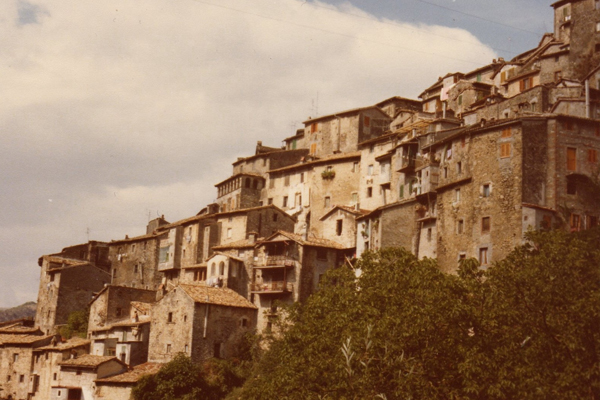
Anticoli CorradoAnticoli Corrado

By Joseph Temple

*** WARNING: SPOILER ALERT ***

Following the successful invasion of Sicily in the summer of 1943, Fascist leader Benito Mussolini is swiftly removed from power while a new Italian government signs an armistice agreement with the Allies. Unfortunately, what appears to be a great triumph for Britain and America ends up becoming a hollow victory.  Within a few short months, German forces occupy Northern Italy and establish a puppet government against those in the south.  The battle for Italy’s future was just beginning.

That is the setting for Stanley Kramer’s 1969 film The Secret of Santa Vittoria starring the late Anthony Quinn and Hardy Krüger.  Based on Robert Crichton’s book, the movie takes place in the small hillside village of Santa Vittoria where the fall of Mussolini has led to a power vacuum.  With indifference amongst the local population to this revolutionary change, Italo Bombolini, the lovable drunk played brilliantly by Quinn suddenly becomes the town’s new mayor.  But after learning that the Germans are on the move, he quickly sobers up and begins mobilizing the entire population to protect its greatest asset—1,317,000 bottles of fine wine.  Hidden safely away in a nearby cave, a game of psychological chess is played by the mayor and Captain von Prum who is eager to steal every single bottle before he and his soldiers leave.

Released during the golden age of World War II movies that included Patton, Tora! Tora! Tora! and The Dirty Dozen, Kramer’s contribution to the genre is noteworthy.  Filmed almost entirely in the Italian commune of Anticoli Corrado, the beautiful scenery is greatly enhanced by numerous locals who were used throughout the movie as extras.  According to IMDB, the actual Santa Vittoria had modernized greatly since 1943, making it impractical for a Second World War period film as production started in 1968.

Adding to its picturesque location, Anthony Quinn steals the show with his larger than life performance.  The buffoonish Bombolini will definitely make you laugh out loud, including one hilarious scene where he intends to punish the man caught sleeping with his daughter.  But he’ll also leave you at the edge of your seat, especially during his intense negotiations with von Prum over the million bottles that have gone missing.  His character makes you realize just how important wine is to Italian culture and why a whole village bases their entire identity on what Krüger’s character facetiously calls “fermented juice.”  Whether its Chianti, Sangiovese or Barbera, the audience never learns exactly what type of wine is being hidden away.  All you know is that giving it away to Germany is like “paying a stranger to sleep with your wife” according to Bombolini.

Unfortunately for the folks at MGM, The Secret of Santa Vittoria didn’t fare well at the box office.  According to Jeffrey Kauffman at blu-ray.com, the year 1969 marked a turning point in the history of film with counterculture movies like Easy Rider taking over the silver screen.  Big budget flicks with older casts had suddenly became yesterdays news, resulting in just $6.5 million in receipts during its initial run.  However, just like a fine wine, the film has gotten better with age.  So whether you’re an oenophile or a history buff, you’ll definitely need to check this out the next time you feel like being in a retro mood. Ciao!


You might also like:

Have you seen The Secret of Santa Vittoria

View Results

Loading ... Loading ...
Ask Sid: Disappointing purchased wines that surprise later on

May 20th, 2015 by Joseph Temple
Ask your question here The International Wine & Food Society

Ask Sid: Disappointing purchased wines that surprise later on

Question: Do you have an example of a wine you purchased that disappointed you but later with cellaring surprised you?

Answer: Great question! Lots I could share. This often happens with the pinot noir variety which doesn’t always develop in a straight line of maturity. Particularly high acidity red Burgundy vintages like 1972 & 1988 with time now have developed into some marvellous fresh delicious bottles. More recently in Burgundy maybe the irregular still tart 1996 and the smaller crop 2010 may be similar – definitely the latter has fruit acidity balance for the future. A recent example from this month is 1975 Chateau Montrose from that very hard tannic vintage. Cellared and drank too early many disappointingly dry austere bottles which definitely needed food. Many 1975 Bordeaux just don’t have enough fruit to out-last those tannins. However, even though it may not be the 100 point 1990 this 1975 now at 40 years of age shows improved old style complexity of true St. Estephe terroir from that over 70% cabernet sauvignon dense fruit less hidden by the strong tannins which are starting to mellow. Surprise or at least patience rewarded!


You might also like:

Has a wine that was dissapointing at first surprised you later on?

View Results

Loading ... Loading ...
Marques de Caceres

May 18th, 2015 by Sidney Cross

Do you know the difference in Rioja among crianza, reserva, and gran reserva?

Do you know the difference in Rioja among crianza, reserva, and gran reserva? At a recent tasting producer Marques de Caceres founded in 1970 by Enrique Forner certainly showed wines displaying these levels with both vineyard age and yields being important keys.

CRIANZA:   Consistent vintage year (presently 2011) best seller in USA 85% tempranillo, 10% spicy garnacha, & 5% graciano aged 12 months in new and used oak French (60%) & American (40%) shows good freshness.

RESERVA:  Better vintages (currently 2008) using same grape mix of older 30 year vines with lower yields (30hl/ha) aged 22 months French oak (1/3 new) displays more concentration & elegance.

GRAN RESERVA: Same grape mix but slightly more natural acidity of graciano (7%) best years (currently 2005) oldest vines and lowest yields aged 26 months in French oak (1/2 new) shows fruit depth with ripe prunes complexity.

Also have a structured GAUDIUM ( “joys of the senses ” in Latin – not the famous Spanish architect Gaudi) GRAN VINO in 2009 (10th one, first one 94) limited production of 94 new French oak barrels (28,200 bottles) 18-20 months where the malolactic fermentation takes place from 95% tempranillo & 5% graciano from 6 special parcels of very old vines with one 1.5 hectare plot pre-phylloxera over 120 years (average 70+) & low yields (18hl/ha) results in more tannins for cellar aging potential.

Appreciated as well the good value of both their fragrant white 100% verdejo (harvested at night in Rueda when temperatures are cooler to intensify their mineral attributes) first own vineyards vintage 2014 but from vines 30-40 years old and fresh flowers Rosado (Rose) from 96% tempranillo & 4% garnacha.


You might also like:

Do you know the difference in Rioja among crianza, reserva, and gran reserva?

View Results

Loading ... Loading ...
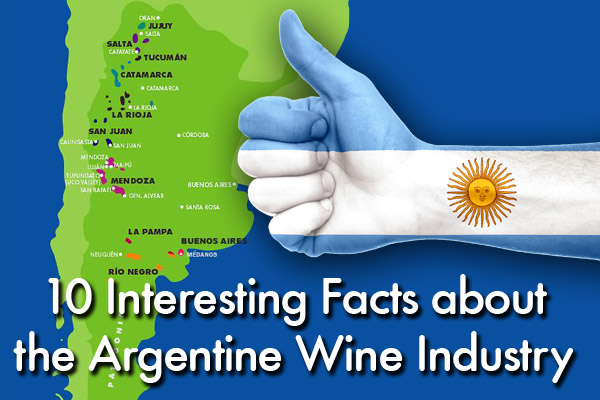
10 interesting facts about the Argentine wine industry

May 15th, 2015 by Joseph Temple

Argentina wines

By Joseph Temple

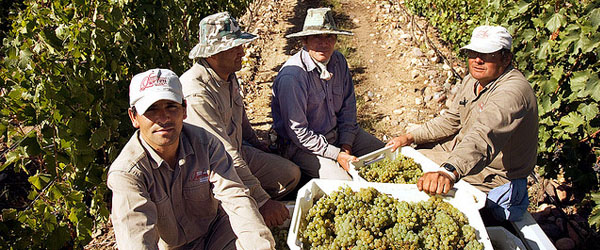
Twenty years ago, few people living outside the borders of Argentina knew about its local wine industry.  Today, exports are at nearly a billion dollars per year, fueled largely by its world-famous Malbec grapes and a cost-friendly price tag (although this may be changing soon).  With Argentine wines being sold across the globe, it’s hard to imagine that at one time, the nation’s growers gave little thought to exports.  Of course, with a per capita consumption of twenty-one gallons per year – one of the highest in the world – satisfying their own people’s thirsty palates took top priority.  But with increased foreign investment, Argentina began aggressively looking at markets beyond South America.  And although the country has become synonymous with Malbec, other varietals including Cabernet Sauvignon, Chardonnay and Sangiovese are being cultivated near the Andes, where the melted snow from the mountain tops is used to nourish the land through an impressive irrigation system.  So for this week, have a look at ten interesting facts about the Argentine wine industry.


Argentine wine production
By Rod Waddington from Kergunyah, Australia [CC BY-SA 2.0], via Wikimedia Commons

1. Argentina is the number one producer of wine in South America
and the world’s sixth-largest producer.
blank
blank

the history of Argentine wine

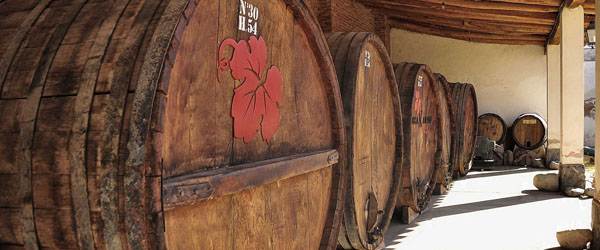
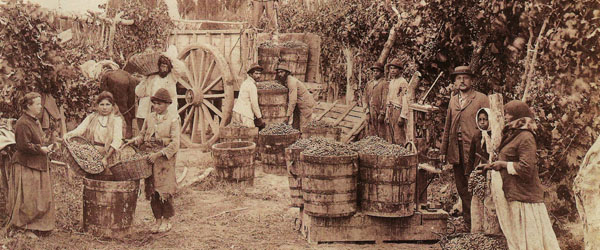
2. Wine grapes have been grown in Argentina since at least the mid-16th century.
blank
blank

Argentina grows more Malbec grapes than any other country
By Fred von Lohmann from san francisco (Wine Tasting: Malbec) [CC BY 2.0], via Wikimedia Commons

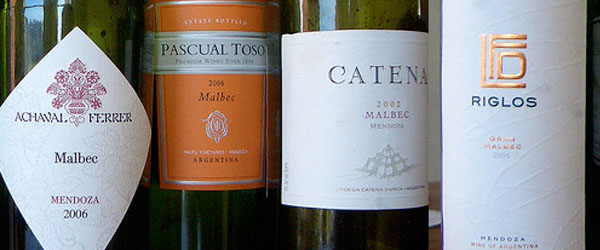
3. More Malbec is grown in Argentina than anywhere else in the world.
blank
blank

Argentina's vineyards have the highest altitudes
By Emilia Garassino [CC BY-SA 2.0], via Wikimedia Commons

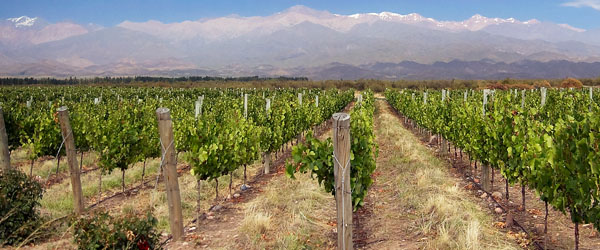
4. Most of the nation’s wine regions are located in the west central part of the country near the foothills of the Andes Mountains. With elevations
up to 4,900 feet above sea level, some of these vineyards have the highest altitudes in the entire world.
blank
blank

Labor and land costs for producing wine in Argentina
By Fabio Ingrosso (Flickr: Francois Lurton, vigneti in Argentina) [CC BY 2.0], via Wikimedia Commons

5. In Argentina, the land and labor costs are roughly $30,000 per acre. In comparison, the same costs per acre in the Napa Valley are $300,000.
blank
blank

Argentina's Mendoza wine region
By European citizen (Own work) [CC BY-SA 3.0 or GFDL], via Wikimedia Commons

6. Mendoza is the largest and most successful region for viticulture in Argentina. Located east of the Andes, it accounts for 70% of the country’s wine production and is the sixth-largest producer of grapes in the entire world.
blank
blank

Argentina railroad wine

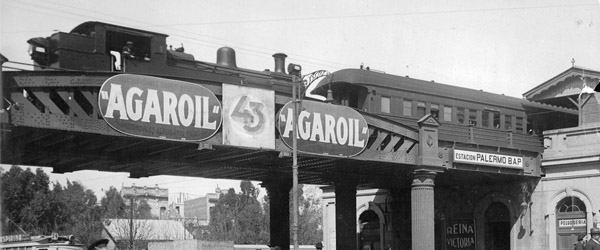
7. With completion of the Mendoza-Buenos Aires railroad in 1882, the region became vital in supplying Argentina’s political and financial capital with agricultural products—including wine.
blank
blank

Argentina's domestic wine industry
By Tjeerd Wiersma (Flickr: Argentinie 123) [CC BY 2.0], via Wikimedia Commons

8. Up until the mid-1990s, Argentina’s wine industry almost exclusively focused on domestic consumption, producing mostly inexpensive wines that were blends from many different grapes.
blank
blank

Hyperinflation in Argentina and its effect on the wine industry

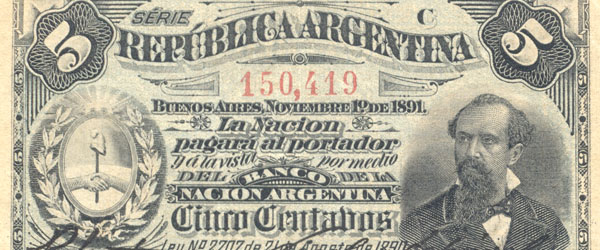
9. In the late 1980s and early 1990s, Argentina experienced hyperinflation at approximately 1,000 percent a year. With price controls placed on wine during this time, many growers shifted away from grape production.
blank
blank

Inflation and its effect on wine in Argentina
By Juan Pelizzatti (Bodegas Chakana) [CC BY 3.0-2.5-2.0-1.0], via Wikimedia Commons

10. Those who stuck with growing wine grapes were given financial incentives to destroy older and traditional varieties in favor of high-yield and inferior varieties designed for domestic consumption.


Sources:

Catena, Laura. Vino Argentino: An Insider’s Guide to the Wines and Wine Country of Argentina. San Francisco: Chronicle Books, 2011.
Koplan, Steven, Smith, Brian H. and Weiss, Michael. Winewise: Your Complete Guide to Understanding, Selecting, and Enjoying Wine. Boston: Houghton Mifflin Harcourt, 2014.
Luongo, Michael, Mroue, Haas and Schreck, Kristina. Frommer’s Argentina and Chile. Hoboken: Wiley Publishing Inc., 2005.
MacNeil, Karen. The Wine Bible. New York: Workman Publishing Company, 2000.
McCarthy, Ed and Ewing-Mulligan, Mary. Wine For Dummies. Hoboken: Wiley Publishing Inc., 2012.
Nowak, Barbara and Wichman, Beverly. The Everything Wine Book: From Chardonnay to Zinfandel, All You Need to Make the Perfect Choice. Avon: Adams Media, 2005.
Parker, Robert M. Parker’s Wine Bargains: The World’s Best Wine Values Under $25. New York: Simon & Schuster, 2009.


You might also like:

Do you like drinking wine from Argentina?

View Results

Loading ... Loading ...
Ask Sid: 2003 Bordeaux

May 13th, 2015 by Joseph Temple
Ask your question here The International Wine & Food Society

How good is 2003 Bordeaux?

Question: I drink mainly New World wines. Just received an inheritance of some red Bordeaux mostly from the 2003 vintage including a case of Chateau Duhart Milon. Any guidance?

Answer: 2003 Bordeaux have some of the characteristics of the riper New World regions because of the heat wave experienced that year so you should enjoy them. Many were made from quite ripe grapes with lower acidity resulting in more forwardly drinking wines. In any event they are over 10 years of age and can be consumed now in that softer style. You have a real treasure in the Duhart a 4th Growth from Pauillac in the 1855 Classification but  much improved under the Lafite Rothschild management. Their replanted vineyards from the 1960s are mature and thriving. I bought this 2003 on futures at what turned out to be a bargain price as every bottle I open is better still and no rush to drink up. Low yields of just over 30hl/ha for the blend of 73% cabernet sauvignon & 27% merlot show that typical cedar cigar box complex bouquet with rich full balanced flavours. A special treat. Lucky you as this is definitely one of the stars of the 2003 vintage!


You might also like:

Have you tried Bordeaux from 2003?

View Results

Loading ... Loading ...
Older Entries
Newer Entries
The object of the Society is to bring together and serve all who believe that a right understanding of good food and wine is an essential part of personal contentment and health and that an intelligent approach to the pleasures and problems of the table offers far greater rewards than the mere satisfaction of appetite.
Andre Simon Wine & Food Society Founder (1933)
© 2025 The International Wine & Food Society (IW&FS) IW&FS
Credits | Privacy | Accessibility