menu
Member Sign In
  • IWFS Homepage
  • Blog Home
  • Forums Home
  • Global Forum
  • Contact Us
Close
  • IWFS Homepage
  • Blog Home
  • Forums Home
  • Global Forum
  • Contact Us
    Member Sign In
  • Blog Home
  • Forum Home
  • Global Forum

Follow Us

Recent Posts

  • OUR 2002 RED BURGUNDY VERTICAL IS AGING WELL, SHOWCASING REFINED PRECISION WITH TERROIR-DRIVEN CHARM
  • Ask Sid: Thoughts of Sid Cross on the Judgement of Paris historic wine tasting at the 50th Anniversary?
  • EDUCATIONAL #AUSSIEWINE SEMINAR “CLASSIC AND CONTEMPORARY AUSTRALIA” BY KNOWLEDGEABLE MARK DAVIDSON WAS A BIG HIT AT @VANWINEFEST
  • Ask Sid: Was it 50 years since California bested France in a Paris wine tasting?
  • HORIZONTAL TASTING OF RED BORDEAUX 2015 SHOWS FRUIT FLESHINESS WITH VARIABILITY + OUTSTANDING BENTO BOX

Archives

  • April 2026
  • March 2026
  • February 2026
  • January 2026
  • December 2025
  • November 2025
  • October 2025
  • September 2025
  • August 2025
  • July 2025
  • June 2025
  • May 2025
  • April 2025
  • March 2025
  • February 2025
  • January 2025
  • December 2024
  • November 2024
  • October 2024
  • September 2024
  • August 2024
  • July 2024
  • June 2024
  • May 2024
  • April 2024
  • March 2024
  • February 2024
  • January 2024
  • December 2023
  • November 2023
  • October 2023
  • September 2023
  • August 2023
  • July 2023
  • June 2023
  • May 2023
  • April 2023
  • March 2023
  • February 2023
  • January 2023
  • December 2022
  • November 2022
  • October 2022
  • September 2022
  • August 2022
  • July 2022
  • June 2022
  • May 2022
  • April 2022
  • March 2022
  • February 2022
  • January 2022
  • December 2021
  • November 2021
  • October 2021
  • September 2021
  • August 2021
  • July 2021
  • June 2021
  • May 2021
  • April 2021
  • March 2021
  • February 2021
  • January 2021
  • December 2020
  • November 2020
  • October 2020
  • September 2020
  • August 2020
  • July 2020
  • June 2020
  • May 2020
  • April 2020
  • March 2020
  • February 2020
  • January 2020
  • December 2019
  • November 2019
  • October 2019
  • September 2019
  • August 2019
  • July 2019
  • June 2019
  • May 2019
  • April 2019
  • March 2019
  • February 2019
  • January 2019
  • December 2018
  • November 2018
  • October 2018
  • September 2018
  • August 2018
  • July 2018
  • June 2018
  • May 2018
  • April 2018
  • March 2018
  • February 2018
  • January 2018
  • December 2017
  • November 2017
  • October 2017
  • September 2017
  • August 2017
  • July 2017
  • June 2017
  • May 2017
  • April 2017
  • March 2017
  • February 2017
  • January 2017
  • December 2016
  • November 2016
  • October 2016
  • September 2016
  • August 2016
  • July 2016
  • June 2016
  • May 2016
  • April 2016
  • March 2016
  • February 2016
  • January 2016
  • December 2015
  • November 2015
  • October 2015
  • September 2015
  • August 2015
  • July 2015
  • June 2015
  • May 2015
  • April 2015
  • March 2015
  • February 2015
  • January 2015
  • December 2014
  • November 2014
  • October 2014
  • September 2014
  • August 2014
  • July 2014
  • June 2014
  • May 2014
  • April 2014
  • March 2014
  • February 2014
  • January 2014
  • December 2013
  • November 2013
  • October 2013
  • September 2013
  • August 2013
  • July 2013
  • June 2013

Meta

  • Log in
  • Entries feed
  • Comments feed
  • WordPress.org

Author Archive

Older Entries
Newer Entries

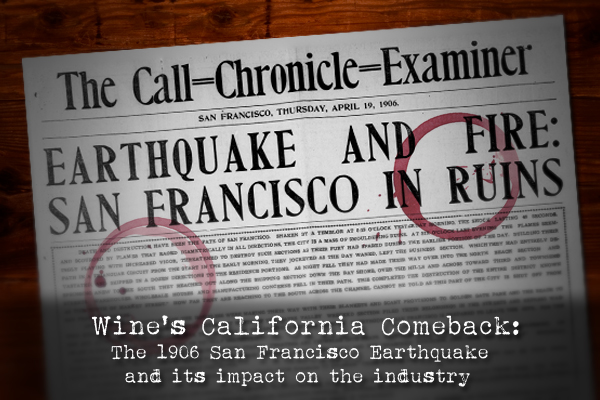
Wine’s California Comeback: The 1906 San Francisco Earthquake and its impact on the industry

August 29th, 2014 by Joseph Temple

Wine's California Comeback: The 1906 San Francisco Earthquake and its impact on the industry.
By Joseph Temple

On Sunday morning, a 6.0-magnitude earthquake hit the San Francisco Bay Area and the surrounding region, injuring hundreds of people and leaving thousands without water and electricity.  There have thankfully been no deaths due to this natural disaster, but an area hit particularly hard is Napa, home to a $13 billion dollar a year wine industry.  According to one report, 33 buildings have been declared unsafe to enter with another 600 properties experiencing water and sewage problems.  The biggest earthquake to hit the Northern California since 1989, the total economic damage is estimated to be in the billions.

For anyone living in the areas affected by this earthquake, two Red Cross evacuation centers are open to those in need – one at the Crosswalk Community Church in Napa at 2590 First Street and another at the Florence Douglas Center at 333 Amador Street in Vallejo.  For those in the wine industry, you can visit Napaearthquake.com, where numerous individuals have offered their help and assistance.

At the International Wine & Food Society, our best wishes go out to the people of the Golden State.  And if history is any indication, we are confident the region will only emerge stronger from this disaster.


One hundred and eight years ago, the epicenter of California’s wine industry was not in the vineyards of Napa or Sonoma, but in the city of San Francisco. With its close proximity to both railroad lines and shipping routes, the Bay Area became an important hub during a time when merchants were in control of both production and distribution.  Firmly entrenched in the city was the powerful California Wine Association (CWA), which controlled nearly 75% of the market as  “the distinction between winegrower and wine merchant was not sharply drawn.”  According to  historian Thomas Pinney, “their [the CWA’s] produce was sent to central cellars in San Francisco where the wines were stored, blended to a uniform standard, bottled, and then shipped for sale … as a monopoly, or rather, near-monopoly, it belonged to the rapacious business style of the late nineteenth century, and, no doubt, if the full record could be known it would show a long tale of sharp practices and dubious moves.”

However, this dominant organization would be rendered helpless on April 18, 1906, when a 7.8-magnitude earthquake rocked San Francisco to its core. With over 28,000 buildings destroyed, 3,000 deaths and half the city left homeless, it is to this day one of the worst natural disasters in American history.

And while some people tried to save their wine from the destruction, in some cases, it was wine that was saving them.


Silent film documenting the aftermath of the 1906 San Francisco earthquake.
Courtesy: Prelinger Archives

With fires spreading throughout the Bay Area and the water supply shut off due to the intense shaking that ruptured nearly 30,000 city pipes, wine became an important weapon to combat the roaring flames.  Luckily, thousands of recent immigrants who successfully fought against statewide prohibition, had homemade wine operations that proved useful in saving San Francisco from total ruin.  “In those days, many Italian immigrants fermented wine in their basement and there are stories of old-timers getting them out and pouring them on the fire,” declared one resident.

At CWA headquarters, efforts were made to salvage whatever they could of its enormous stockpile.  Using a city-owned fire engine, a million and a half gallons of wine was pumped out from one of their still burning cellars and placed into a barge where it was then distilled into brandy.  Still, the CWA lost approximately 10,000,000 gallons due to the earthquake, while its competitor, the Italian Swiss Colony (a company also located in the area) lost over 12,000,000 gallons and roughly $3,500,000 (over $88,000,000 in today’s dollars) in damages to their building and the equipment inside it.
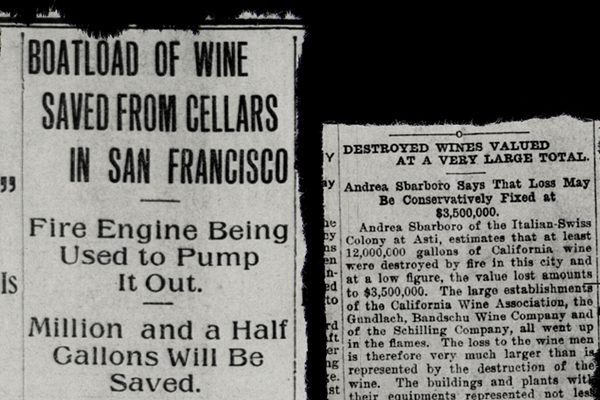
Wine articles about the earthquake
Newspaper articles reporting on the disaster.
Credit: California Digital Newspaper Collection.

In the aftermath of this devastating disaster, the wine industry learned a painful lesson on the dangers of centralization.  W. Blake Grey of the San Francisco Chronicle writes, “With their headquarters and most of their wine destroyed, wineries moved their operation closer to the grapes, and thus what we now think of as Wine Country was also changed forever.”  Remarkably, after just a few years of restructuring, the California wine industry successfully rebounded from this devastating loss.

Whether an earthquake, phylloxera, numerous droughts, two economic depressions or thirteen painful years of prohibition, the Golden State and its wine have clearly faced numerous challenges over the past century.  Yet after each of these catastrophic events, California fights back, becoming an undisputed leader around the globe for quality wine.  If history is any indication of the resilience of Californians and their wine industry, they are sure to overcome this most recent devastation and maintain their world class designation.

Ask Sid: Toasts?

August 27th, 2014 by Joseph Temple

Toasting

Question: Would you share your top 10 toasts? I could also use one for a rehearsal dinner for my son’s wedding too.

Answer: Not big on memorized rigid toasts. Prefer to personalize something to the actual person or specific occasion. I would suggest you do the same for your son’s wedding. However there are hundreds of proven popular ones on the web that you could use or adapt by just googling wedding toasts. When I practised law I used Shakespeare’s Taming of the Shrew: “And do as adversaries do in law, strive mightily, but eat and drink as friends”. Now older and more philosophical I like Robert Louis Stevenson: “A bottle of good wine, like a good act, shines ever in the retrospect”.

I often finish with a short one word toast in a specific language so my top 10 go to are simple:

1. Cheers  English
2. Chimo  Eskimo
3. A Votre Sante France
4. Prost German
5. Cin Cin (Chin-Chin ) Italy
6. Skol Sweden
7. Kampai Japan
8. Salut (Sah-Lud) Spain
9. Gan Bay China
10. Yass-Ooh Greece

Have you ever given a toast?

View Results

Loading ... Loading ...

A Look At 5 Iconic Florida Restaurants

August 22nd, 2014 by Joseph Temple

Florida Restaurants

By Joseph Temple

With an economy based largely on tourism, it’s no surprise that Florida has a strong culinary history.  As people from around the world began flocking to the Sunshine State after completion of the Florida East Coast Railway, it was only natural that the number of restaurants would grow exponentially.  From the panhandle to the keys, numerous eateries have left an impact not only on the palates of Floridians, but on the country at large.

Below you can read about five of these iconic establishments.  For those looking to learn more about the restaurants and unique dishes of Miami, you can read IW&FS members Vicki and Joe Garrigo’s excellent article titled Cuisine of the Sun. Special thanks to FloridaMemory.com for providing most of the photos for this piece.

block


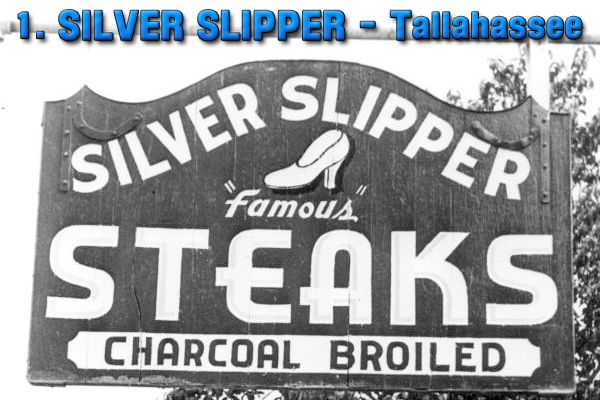
Silver Slipper Restaurant in Tallahassee
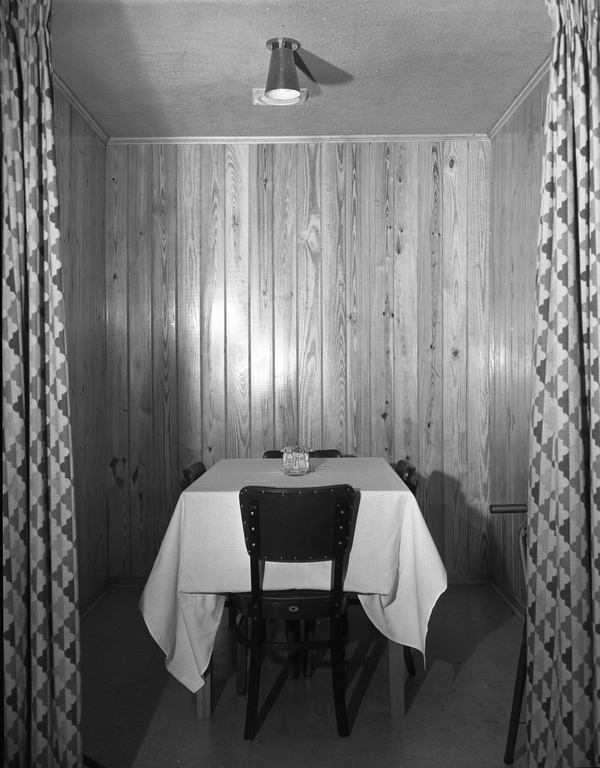
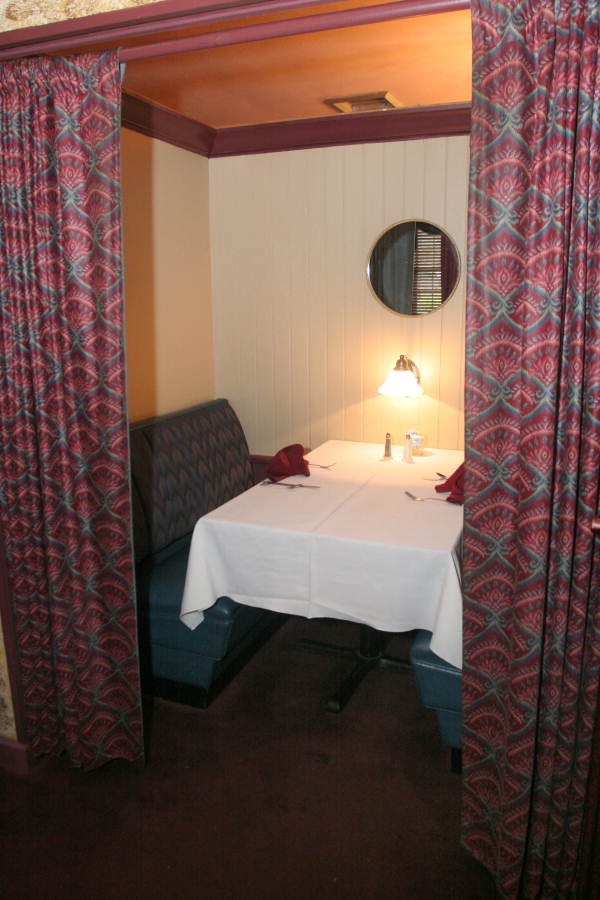
Opening its doors for the first time in 1938, the Silver Slipper became famous for both its juicy steaks and a first class clientele that included JFK, Ronald Reagan, and numerous movie stars visiting Florida’s capital city.  Of course, with its unique floor plan consisting of several alcoves that could be curtained off, one can only imagine how many backroom deals were brokered by state legislators inside this restaurant.  “There was a saying … some of the significant bills of a legislative session were first passed, or defeated, in one of the curtained rooms at the Slipper.”

Private alcove in the Silver Slipper  private room at the Silver Slipper restaurant

The private alcoves inside the Silver Slipper, circa 1961 and 2009. (click to enlarge both)

block


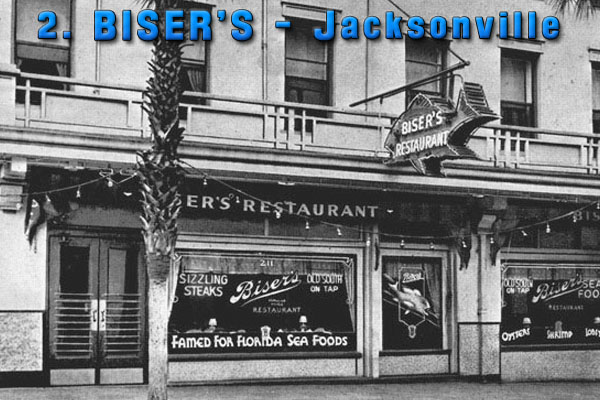
Bisers Jacksonville

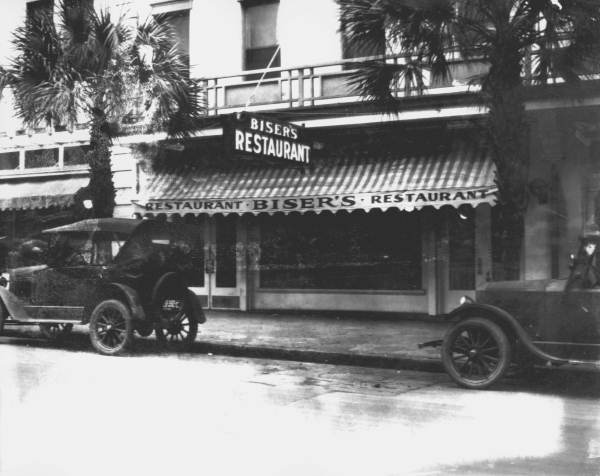
Known for its legendary red snapper and a neon sign in the shape of this most iconic dish, Biser’s became a mainstay for Jacksonville diners until its demise in 1968.   With several locations throughout its existence, the most profitable period came during its time at 211 Forsyth Street where the owner Howard Biser served “sea foods cooked by old Southern recipes, which preserve the tang of the sea and satisfy the appetite.” This, in addition to pouring “the best cup of coffee in the state of Florida,” turned Biser’s into a River City landmark.

 Bisers Restaurant Jacksonville 1920 Bisers Restaurant Interior

(Left) Biser’s Restaurant, circa 1920s. (Right) Interior of Biser’s, circa 1940s.

block


Mai Kai Fort Lauderdale

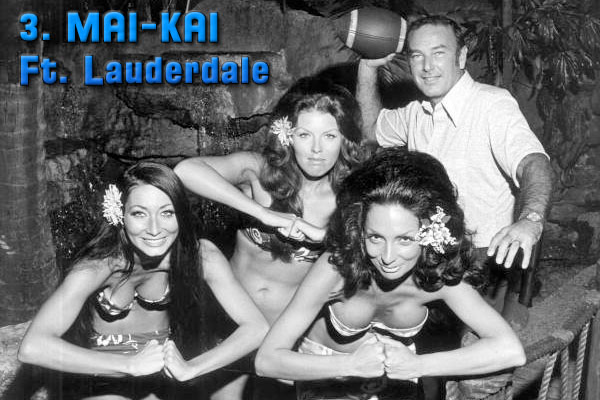
Beginning in 1956, this Polynesian tiki-themed restaurant featured  “a troupe of flame-throwing, hip-gyrating, ukulele-playing performers [that] wow the well-fed, rum-soaked dinner crowd.”  But its greatest publicist was legendary late-night talk show host Johnny Carson who promoted the restaurant on the air many times, especially the grass-skirt wearing “Mystery Girl” who delivered a mystery drink to the many guests of the Mai-Kai.

 Mai Kai Restaurant Fort Lauderdale  Mai Kai restaurant

Polynesian dancers at the Mai-Kai, circa late 1960s.

block


Columbia Restaurant Ybor City

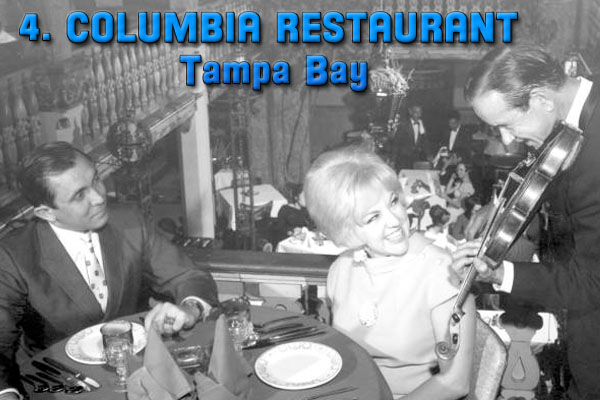
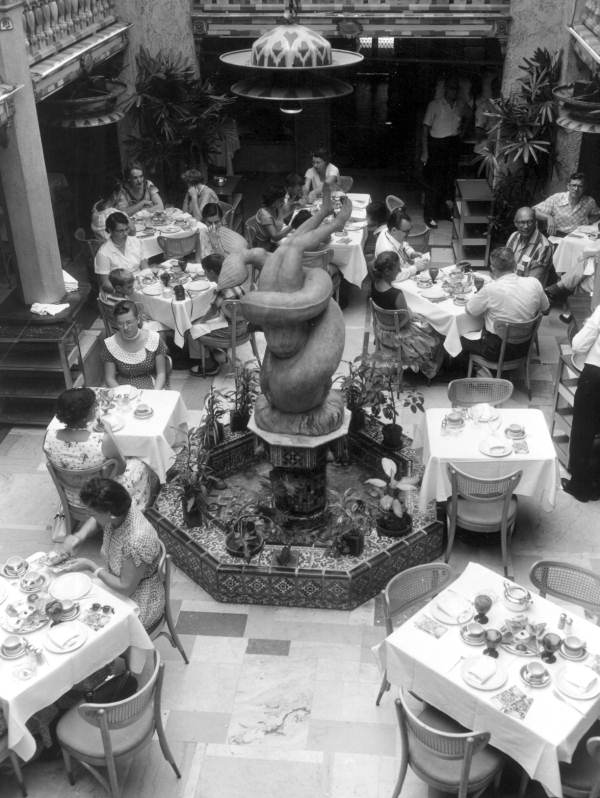
Since 1905, this Spanish restaurant has been the gem of Ybor City, Tampa’s historic cigar rolling neighborhood.  Designed to resemble an Andalusian courtyard, its mosaic tiled fountain and a three-hundred seat showroom has featured various Latin talent to central Floridians for decades, becoming both a culinary and cultural hotspot.  Whether its Chicken Alicante, Spanish Omelets, gazpacho, or its signature dish, Arroz con Pollo Valenciana, there’s something for everybody at this landmark establishment.

 Columbia Restaurant Ybor City Tampa  Tampa Columbia Restaurant

(Left) Spanish performers at Columbia Restaurant, 1968. (Right) Courtyard.

block


Garys Duck Inn Orlando

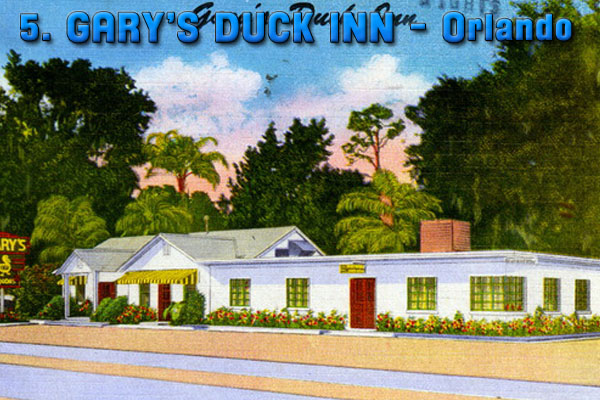
If you were ever driving along the South Orange Blossom Trail in 1950 with $3.65 in your pocket, then all the lobster you could eat was waiting for you at Gary’s Duck Inn – the inspiration for the multi-billion dollar Red Lobster chain of seafood restaurants.  Before interstate highways, this Orlando institution was a favorite for locals and tourists who wanted to enjoy a broiled mullet dinner complete with biscuits, coleslaw and hush puppies.


With branches in Jacksonville, Miami, Orlando, Naples & Palm Beach, the International Wine & Food Society is strong across the entire state of Florida. Perhaps these locals can chime in on their favorite restaurants in the Sunshine State?

Did you ever dine at one of these restaurants?

View Results

Loading ... Loading ...

Ask Sid: Chablis vineyards

August 20th, 2014 by Joseph Temple

Vineyards in the Chablis wine region
By CocktailSteward (Own work) [GFDL or CC BY 3.0], via Wikimedia Commons

Question: I have been reading your thought provoking weekly blogs and notice you drink Chablis so am wondering what is your favorite vineyard there?

Answer: Difficult question but I like it. Producers and price are also very important factors to consider.  At Premier Cru level I admire the two vineyards that directly adjoin the Grand Crus:

Montee De Tonnerre continuing the line East from Blanchots with shallow calcareous soil over kimmeridgean sub facing S/SE

Vaulorent (within Fourchaume the largest 1er) at the other end adjoining Preuses with marl facing mainly W/SE

Enjoy all 7 Grand Cru with their distinct characteristics from the floral delicacy of Vaudesir to the body & structure of Valmur  but if forced to pick one I choose:

Les Clos (the largest Grand Cru) faces south on a mix of soils including stones & paler clay (not much marl) but special   limestone providing acidity, power and amazing ageing ability!

Do you drink wine from Chablis?

View Results

Loading ... Loading ...

French Paradox: How a 60 Minutes segment transformed red wine consumption in America

August 15th, 2014 by Joseph Temple

60 Minutes segment on the French Paradox

By Joseph Temple

One book that should be on every wine aficionado’s reading list is George Taber’s A Toast to Bargain Wines.  Chronicling the numerous trends and developments throughout the history of wine, his chapter discussing the 1980s and early 1990s is a truly fascinating read.  Known by many as the ‘neo-prohibition’ period in America, the lobbying group Mothers Against Drunk Driving (MADD) was at the apex in terms of political power, having wine (along with other alcoholic drinks) successfully lumped in the same category as marijuana and other “gateway drugs” plaguing society.  With sales softening and multinational corporations like Nestle and Coca-Cola selling off their investments in the vineyards of California, the industry was clearly on the ropes.

But on November 17, 1991, United States vintners got a gigantic boost from an unlikely source.  For years, representatives from the wine lobby had been trying to educate both politicians and the general public about the supposed health benefits of drinking wine in moderation.  All of these efforts however paled in comparison to the free publicity they received from America’s number one television program, with an estimated audience of over twenty million viewers who tuned in that night.

Hosted by Morley Safer, a 60 Minutes segment titled ‘French Paradox’ attempted to solve the mystery regarding French and American diets – and the odd results these contrasting diets had on the health of each nation.  The former, which consumed such rich delicacies as foie gras, duck, black pudding, and forty pounds of cheese annually per person, remarkably resulted in less cases of heart disease than the latter.  And yet, despite the fact that Americans exercised more regularly than their French counterparts, how could the average Parisian be in better health than the average New Yorker?

The answer to this paradox: red wine.

The segment boasted that by drinking at least one glass a day, the risk of heart attacks and blood clots would be greatly reduced.  At least, that was the conclusion viewers were left with on that particular Sunday night.  And on Monday morning, a tidal wave of consumer interest in red wine was rippling through the United States.

Discussing the segment’s impact, Taber writes, “People in the California wine business still tell of how Americans went rushing out to buy bottles of red wine that Sunday night.  The traditional toast  “To your health” suddenly had a new meaning.  Red wine sales soared.”  Despite being in a short, but sharp recession that year, bottles flew off the shelves as baby boomers were entering their prime earning potential.  The result: the number of California wineries shot up from 807 in 1990 to 1,950 a decade later as “eating” now became “dining” and ordering “a glass of white wine” at a restaurant was replaced by ordering “a glass of chardonnay.”

Almost twenty-three years after the show first aired, the wine industry is still sending thank you cards to CBS!

You can watch a four minute clip from the segment by clicking here.

Is red wine the answer to the French Paradox?

View Results

Loading ... Loading ...
Older Entries
Newer Entries
The object of the Society is to bring together and serve all who believe that a right understanding of good food and wine is an essential part of personal contentment and health and that an intelligent approach to the pleasures and problems of the table offers far greater rewards than the mere satisfaction of appetite.
Andre Simon Wine & Food Society Founder (1933)
© 2026 The International Wine & Food Society (IW&FS) IW&FS
Credits | Privacy | Accessibility